The World is Your Oyster
We’ve just crossed a quarter of the 21st century and things are looking more uncertain than ever before. Speed seems to be the new mantra. Either adapt or perish. A mantra known to mankind since Darwin. The only difference is, it’s a lot starker today.
Look at content creators across social media platforms and you’ll notice a fear. A fear that their content will go stale in a span of 7 days. A week. That’s the speed we’re up against.
Never in human history have we had such high stakes with such short timelines. But these same challenges have also brought in new opportunities.
Look at India, for example. We’ve got the largest young population, some of the cheapest mobile data in the world, UPI, and several tools priced in rupees. ChatGPT Go is ₹399 a month. Google’s Gemini is free.
In 2026, unlike in the 1960s, a teenager in Indore — a tier-2 town that once lacked basic infrastructure — can access the same tools as any other teenager across the world. The barriers to entry/exposure have vanished.
Why Now?
Just a couple of years ago, what a ten-member team executed has suddenly become possible for one person to execute.
Thanks to this, we’re going to see an unprecedented jump in the number of solopreneurs. One-person businesses have already gained popularity after covid. We’re only going to see them increase further as AI gets better.
The students who experiment, learn and spend their time learning about the various facets of AI will stand out — not just in their careers but in the opportunities that knock on their doors.
And people who follow systems and are disciplined are the ones who’ll run several businesses at once.
If you’re a teenager and you’re curious, this is one of the most interesting times to be alive. Even if you never want to start a business, the doors that AI is going to open are numerous.
Before anything else: set a target to fail
The point here is to learn execution.
Your idea matters. But only up to a point. Do you enjoy the topic? And do you know how you’d make money from it?
Most people end up marrying their idea. Or they put so much pressure on themselves that failing becomes unbearable.
You’re a teenager. This is your time to experiment. This is your time to take risks.
Go in with this mindset: 99% of the time, you will fail.
So set a target to fail. I have to fail 10 times this year.
That does two things. It makes failing bearable. And it gives you a number to evaluate against. If you failed fewer than 10 times, you didn’t try enough. Or you were too scared to fail.
Give little to no value to your idea. Focus on execution.
With the world playing on a level field compared to 30/40 years ago, there’s no reason you cannot kick off experiments, test ideas, and own a small piece of the internet.
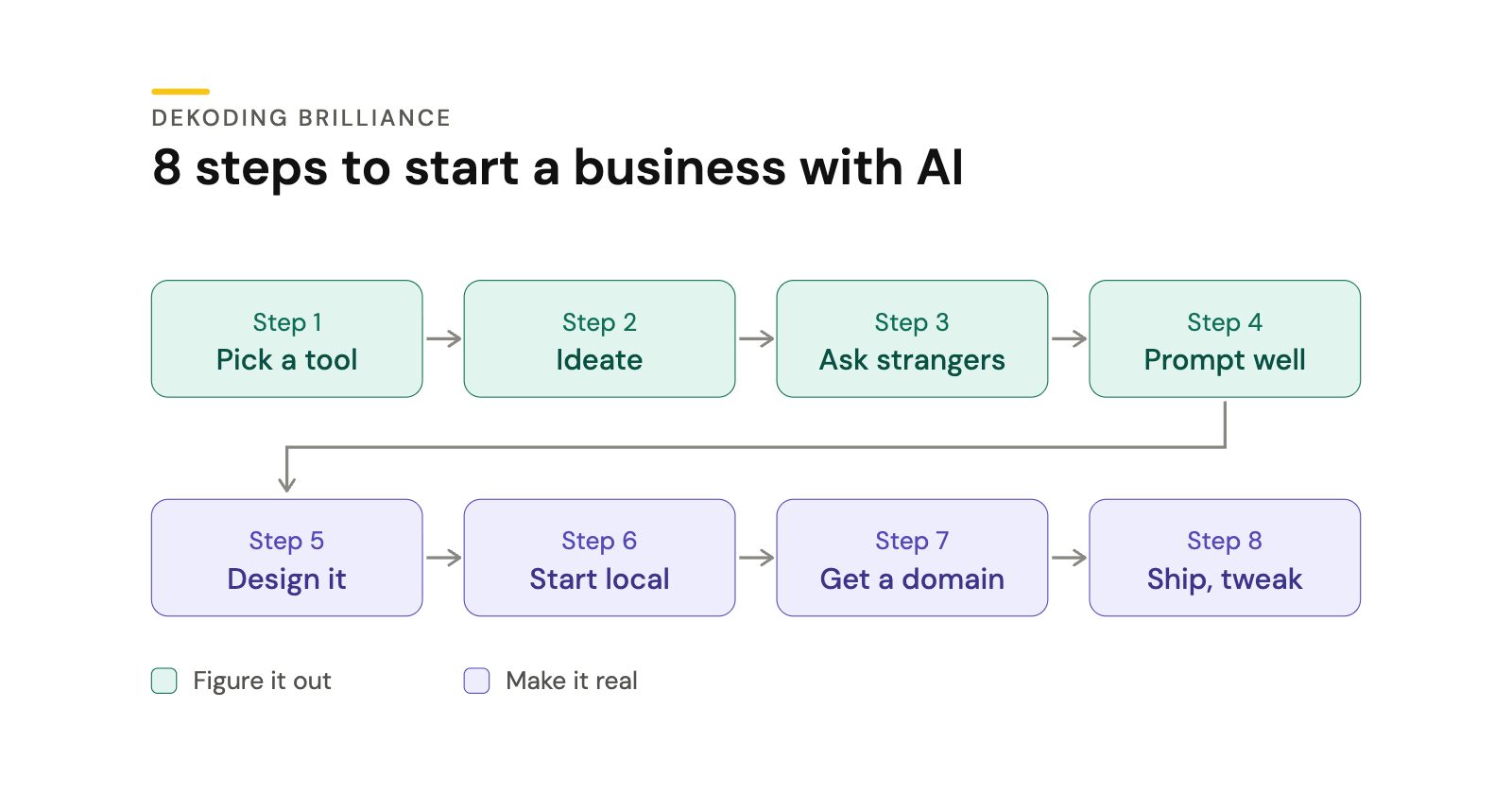
Let’s look at 8 steps through which a teenager in India can kick off a business.
1. Just start using an AI tool
Even if you don’t know how.
The tools have come so far that just asking questions gets you moving. You’ll start building an idea. You’ll start turning that idea into a real product.
Here are some tools to kick start your AI journey in India:
- To think and write: ChatGPT (free, or ₹399/month for Go), Google Gemini (free), or Claude.
- To build without code: Claude, Lovable, Bolt, or Replit turn plain-English prompts into working websites and apps.
- To design: Claude, Canva’s AI features, plus the design built into the tools above.
One honest note on age: most of these list 18 as the minimum in their terms, or 13+ with a parent’s consent. In practice a 15-year-old signs up with a parent’s account and card. That’s not a workaround — it’s the same parent who’ll hold your payment account later, so loop them in from day one.
2. Ideate, but hold it loosely
As discussed above, in the “set a target to fail” section, the important thing is to execute and not worry too much about the idea at this stage.
Once you learn, the learning will stay with you forever. Aim for that.
3. Talk to strangers, not your friends
Talk to people. Not your friends. Strangers.
6 to 10 strangers are enough to test your idea. AI will happily suggest how to find them and what to ask.
This tells you one thing. Will people pay for your idea or not?
Where do you find them safely? Start where there’s already some trust: parents’ friends and colleagues, teachers, your school’s alumni network, local shopkeepers and small business owners near you, and interest-based communities on Discord, Reddit, or WhatsApp groups your parents can see.
Keep first conversations in public or on video, tell a parent who you’re talking to, and never hand over money or personal details to “test” an idea. Ten short conversations is plenty.
4. Learn what to prompt
Knowing what to prompt helps you in two ways.
It uses fewer tokens. That keeps your costs low.
It also cuts down the mistakes AI makes while building your idea.
My tokens were getting used up pretty quickly during the initial days with my experimental website www.ratemychance.com
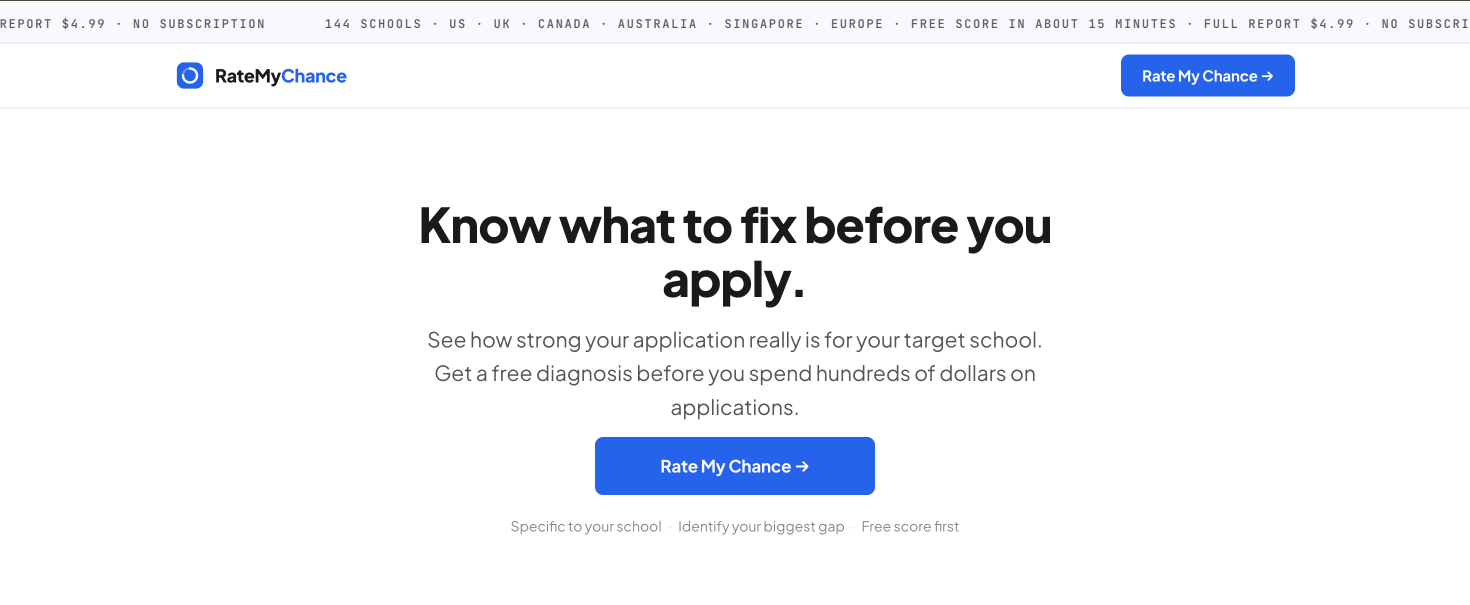
But the longer I kept going, the more ways I learnt to improve my prompts, reduce the mistakes AI made, and get the desired results without having to wait for my tokens to refresh.
5. Let AI design it
AI has gotten much better at design in the last few years.
Use it for web pages. Content. Flywheels. Processes. Mobile apps. It works for how things look and for how they feel to use.
It has gotten better with both UI & UX outputs.
6. Keep it small and local
Start local. That’s the best way in.
Focus on landing one customer.
What you’re really building is a muscle. Idea. Plan. Design. Execute. The full cycle, no matter how small.
That alone puts you ahead of 95% of people your age.
7. Pick your tools
There are several tools that let you host a domain, buy a site, and run your experiment.
The point is simple. Reach the finish line.
The main ones, with 2026 rupee prices: a domain from Hostinger or GoDaddy (a .in runs about ₹599–899 for the first year, a .com about ₹1,000–1,500), hosting from ₹89/month — or free to start on Vercel or Netlify — and your parent’s UPI to take payments while you experiment (move to Razorpay later, if it takes off).
8. Execute and tweak
Run as many ideas on the internet as you can. Each one teaches you a different part of running a business.
The point is to finish what you start.
Put all these skills together and they’ll help you your whole life. The world is only getting more dependent on AI.
What this actually costs in India
You can start for almost nothing and add cost only as you grow. Here’s the real 2026 picture in rupees:
| What you’re paying for | Cheapest way to start | Typical cost |
|---|---|---|
| Domain name | .in from ~₹599/yr, .com from ~₹1,000/yr | ₹50–125/mo (billed yearly) |
| Hosting | Free on Vercel or Netlify; paid from ₹89/mo | ₹0–599/mo |
| AI tool | Gemini free; ChatGPT Go ₹399/mo; Plus ₹1,999/mo | ₹0–9,999/mo (up to Claude Max) |
So a lean start — free hosting, free Gemini, a .in domain — costs roughly ₹50–100 a month. Add ChatGPT Go and you’re near ₹450 a month. Taking payments is free while you experiment on UPI; a gateway like Razorpay only charges once you scale — about ₹12 on a ₹500 order, so you keep around ₹488.
Can a teenager in India actually do this?
Short answer: yes — with a parent as the legal anchor. Here’s the honest breakdown, because this is the part every parent wants to know and almost no one writes about.
The one hard rule. Under the Indian Contract Act, 1872, anyone under 18 cannot sign a binding contract — such agreements are “void from the start.” That means a minor can’t legally hold a business, own a payment-gateway account, or sign up for paid services in their own name.
What a teenager can do. RBI rules let minors aged 10 and above operate their own savings account and use UPI, within bank-set limits. Apps like FamPay and Junio also give teens a UPI handle. So a teenager can bank, transact, and learn the money side hands-on.
The simple way to start: UPI. While your idea is still an experiment, you don’t need a payment gateway at all. Use a parent’s UPI. It costs nothing, sets up in minutes, and easily handles your first payments.
When it takes off, move to Razorpay. Once money is coming in regularly, set up a proper payment gateway. Razorpay needs a PAN, a bank account, and KYC — so a parent or guardian holds the account and earnings settle there. You build and run everything; the parent is the legal owner on paper.
The clean way to start:
- Build the product, write the prompts, talk to customers, ship and tweak.
- Use your parents’ UPI.
- Payments settle into the parent’s linked bank account.
- Keep a simple record of what’s earned — good habit, and it matters at tax time.
FAQ
How much money do I need to start a business with AI in India?
Can a minor legally start a business in India?
Which AI tools can a 15-year-old use in India?
How do I take payments if I’m under 18?
How do I test my idea before building it?
Do I need to know how to code?
Want to actually build one?
The Builder’s Sprint is a 6-week program where you ship a real AI-powered product. Twelve students a cohort.
Explore The Builder’s SprintWhat next? Are you ready to dive in?
The effort is low. You can do it from home. It’s at your fingertips.
AI is growing right now. You get to try and grow with it.
Start sooner. Stay longer. Your chances go up.
AI skills are here to stay. They work across different roles and industries.
The golden period is now. Don’t let it shut on you.

Nimish · Founder & CEO
20+ years in product and growth, including scaling redBus from 500,000 to 5 million users. MBA from Thunderbird, and founder of Dekoding Brilliance, where he designs hands-on programs that teach high-schoolers to build, research, and think like operators.