Passion is invisible, projects aren’t
Every year, millions of students write the same sentence on their applications: “I’m passionate about entrepreneurship and technology.”
The problem? So does everyone else. Passion is invisible. It’s a claim, and claims are free. Anyone can type one.
A project is different. A real thing you built, that real people actually use, is impossible to fake.
So this guide isn’t really about making money. It’s about building proof. Proof that you can look at the world, spot a real problem, and make something that solves it. That skill will matter for the rest of your life, in any field you choose.
And here’s the good news almost nobody tells you: you don’t need a genius idea to start. You’ve probably been told that great ideas arrive in a flash. A shower thought. A stroke of luck. That’s a myth, and an expensive one, because it keeps people sitting around for years waiting for lightning that never strikes.
The best ideas aren’t invented. They’re found. They’re already out there, hiding in the everyday frustrations of real people. You don’t dream them up. You notice them. And noticing is a skill you can start learning today.
The bottleneck moved
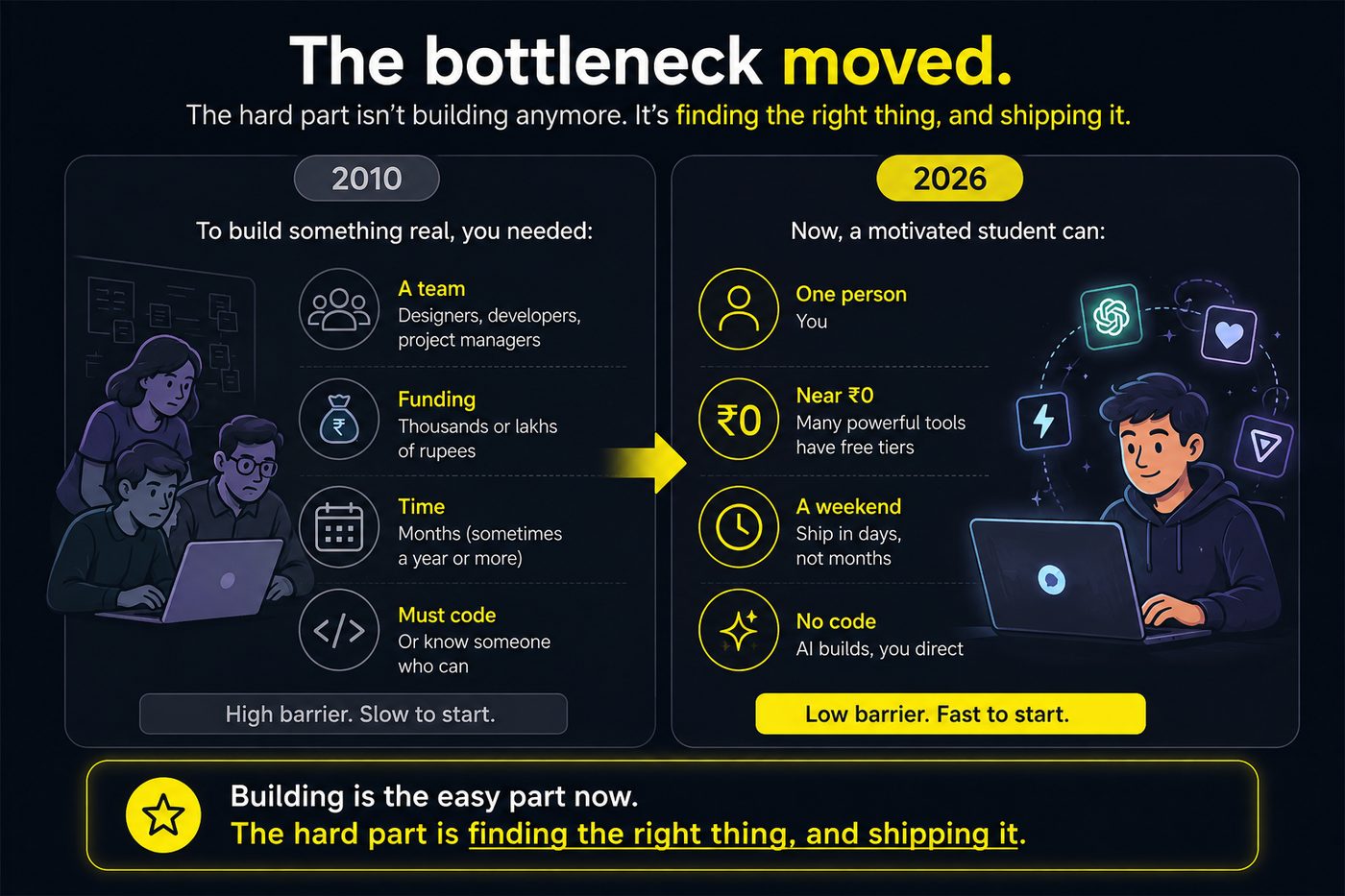
Twenty years ago, building something real meant learning to code, hiring designers, paying developers, and spending months. Today a motivated 15-year-old with AI can find an idea, design a brand, build a website, write the marketing, and talk to customers in a single weekend, for close to zero rupees.
So the hard part changed. It’s no longer “can you build it.” Building is the easy part now. The hard part is finding the right thing to build, and being the person who actually ships it.
Those two things don’t need money or a computer science degree. They need attention and a bit of guts. This guide is about both.
The Builder Principles
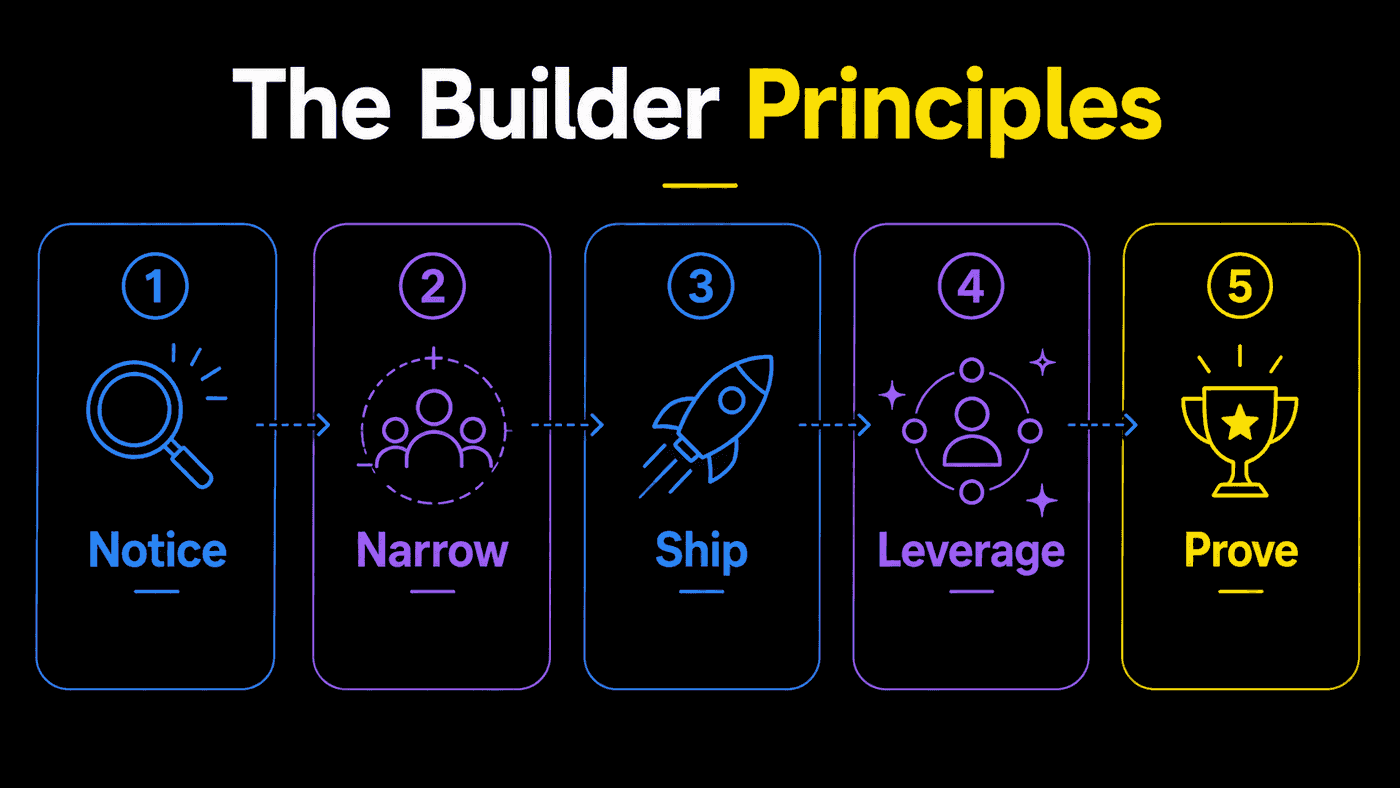
They’re ours, shaped over time from watching what actually works. They’re inspired by entrepreneurs and thinkers like Peter Thiel, Alex Hormozi, and Dan Koe, and adapted for students building their first real things. But you’ll leave here holding the five moves, not a reading list.
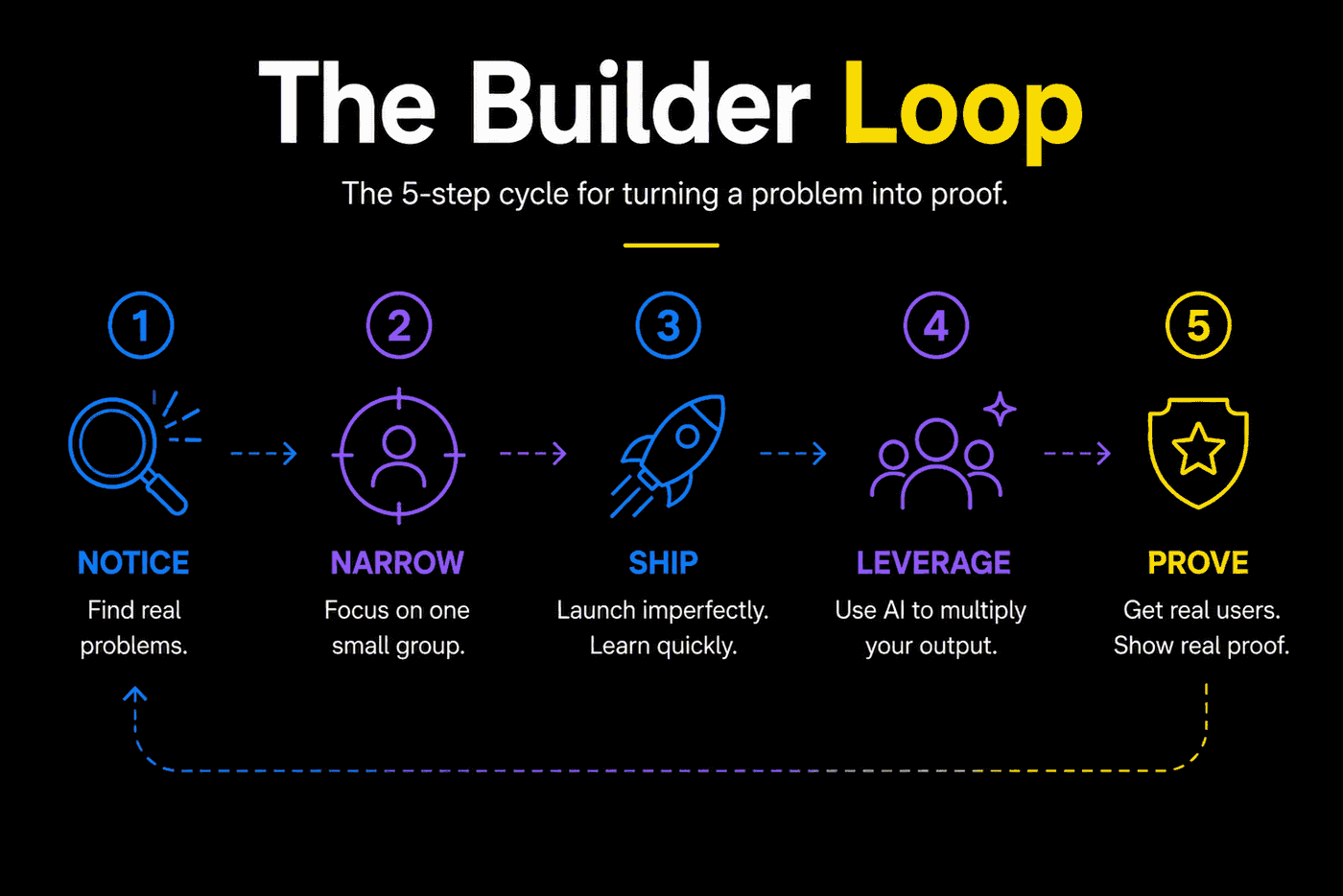
Notice. Narrow. Ship. Leverage. Prove.
1. Notice
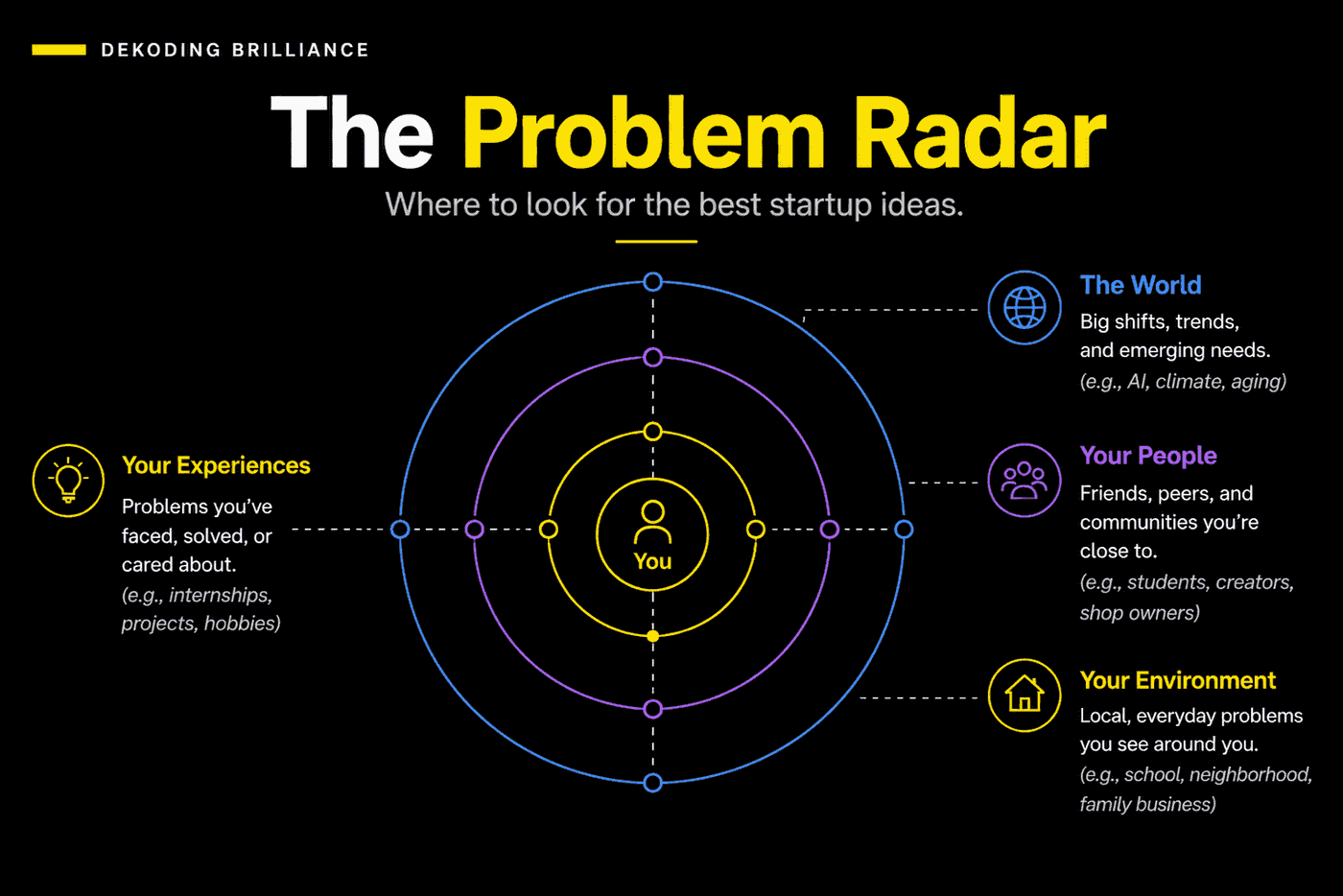
Collect frustrations, don’t chase ideas.
Right now, somewhere, someone is saying “I wish there was a way to just handle this,” or “does anyone know a tool that does this?” They’re not only complaining. They’re telling you, out loud, exactly what they’d pay for. Most people scroll past it. A builder reads it as an instruction.
This is the whole flip. Amateurs start with “here’s my idea, who wants it?” Builders start with “here’s a problem people already have, let me solve it.” One is a guess. The other is nearly a sure thing, because the demand was there before you arrived.
There’s a simple test for whether a fix is worth building. People say yes when it gives them something they really want. And when getting it is fast and easy. If your thing does that, they’ll take it. If it’s slow or a pain to use, they won’t. However clever it is.
Look at what quietly makes money from this. A tool that collects a business’s happy customer reviews and turns them into a shareable wall reportedly earns around $83,000 a month. Not glamorous. Deeply wanted. Someone was tired of chasing testimonials by hand, and somebody built the fix.
Your student-sized versions of “notice a frustration, build the fix”:
- Everyone in your class re-types the same messy notes before every test. Build a tool that turns a photo of notes into one clean revision sheet.
- Your club runs sign-ups through ten different WhatsApp polls. Build one link that collects them all.
- Nobody can ever find the good photos after a school event. Build a page that gathers and shares them.
None of these are exciting on paper. All of them solve a real ache someone has this week.
Try this (10 minutes over 3 days): Keep a note in your phone titled “Ugh.” Every time you or someone near you says “I wish there was a way to…”, write it down. Don’t judge the entries. The one that shows up most is your first real idea, and you didn’t invent any of it. You collected it.
2. Narrow
Own one small group completely.
Most people build for everyone, so they end up being the first choice of no one. “A fitness app.” “A study app.” “A dating app.” Big, vague, and already crowded with better-funded competitors who will crush you.
The move that wins is the opposite. Competing with everyone is how you lose. Instead, pick a market so small that you can own all of it. Be the only real option for one tiny group. Then, once you own that pond, make it bigger.
The proof is everywhere once you look. There’s a fitness-focused dating app reportedly making around $277,000 a year at an 80% profit margin. It didn’t beat Tinder. It served exactly one kind of person, people whose whole life is fitness, better than Tinder ever could. As builders like to say, “the riches are in the niches.”
For a big company, tiny markets aren’t worth the effort. For you, that’s the opening. You can understand one small group better than any company on earth, because you’re standing inside it.
So pick a group you already belong to. Your coaching batch. Your team. The 60 kids sitting the same exam as you. Build the one tool that group would use, and nothing wider:
- Not “a study app.” A tool that drills the exact 30 diagrams on the NEET biology paper, and stops there.
- Not “a sports app.” A batting tracker for your school team, so every player sees their strike rate after each match.
The narrower it sounds, the better it usually is. “For everyone” is where ideas quietly go to die.
Try this (5 minutes): Say this out loud and fill the blank: “I’m going to build the one tool that the ___ would actually use.” Use the smallest, most specific group you honestly belong to. If it feels almost too small, you’ve probably got it right.
Not every problem is worth your time
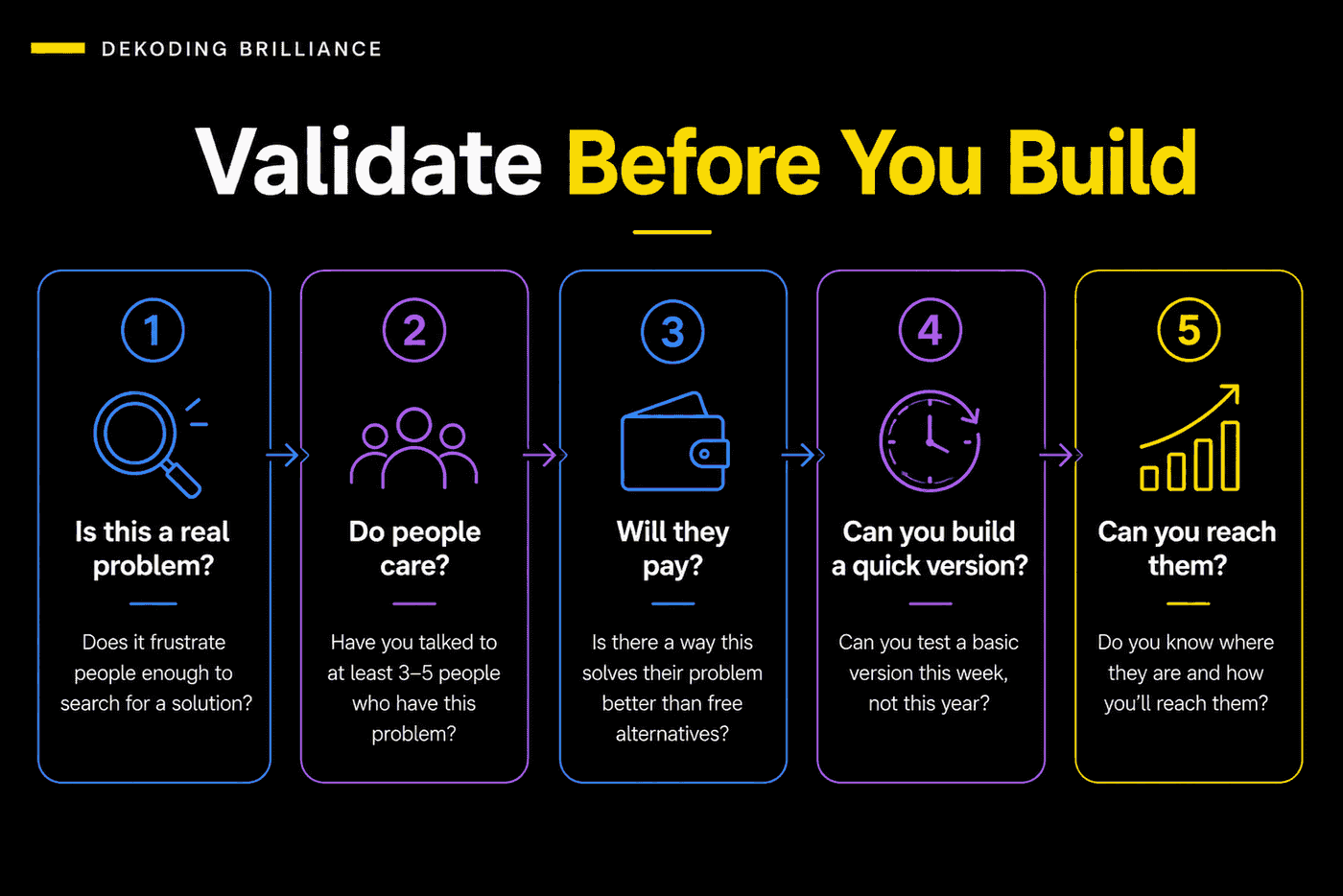
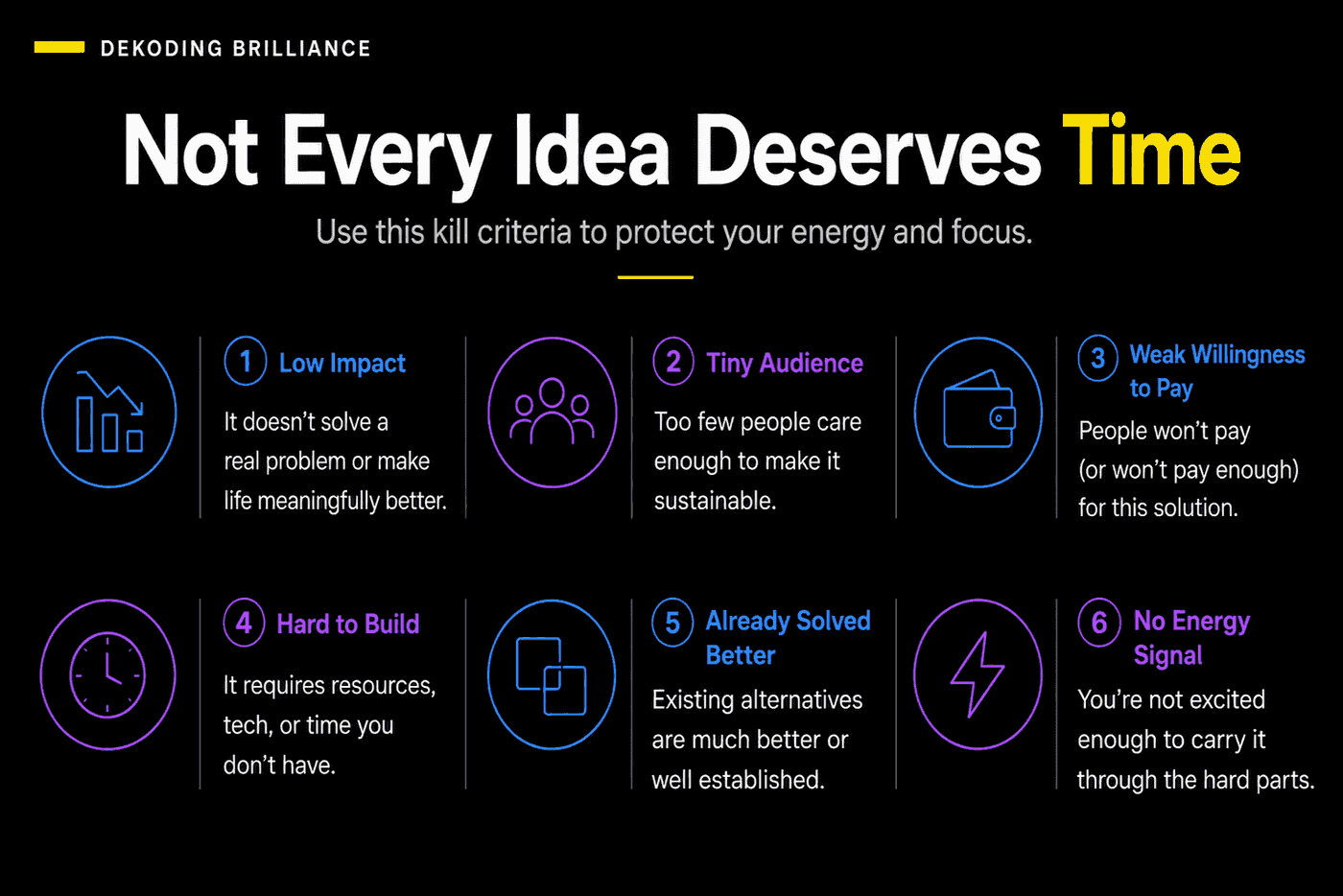
Noticing problems is step one. But not every problem is worth building for. Some are too small. Some are already solved better by someone else. Some you’re just not excited enough to see through. Before you spend a weekend building, run the idea through a few quick checks. If it fails a couple of them, don’t build it yet. Park it, and keep looking. Saying no to a weak idea is how you protect your time for a strong one.
3. Ship
Launch ugly. Learn fast.
Here’s the mistake that kills more projects than any other. People build in private for months, polishing something nobody has seen, certain it must be perfect before anyone can look. Then they finally show the world, and the world shrugs, because they built the wrong thing beautifully.
The builders who win do the opposite. They ship an ugly, half-working first version fast, put it in front of real people, and let reality tell them what to fix. Every confused face is a free lesson. You can’t get those lessons in private. Perfect is just a nicer word for hiding.
The whole job is one loop:
Ship something small → watch a real person use it → fix the one thing that confused them → repeat.
That’s it. Do that ten times and you’ll have something genuinely good, and you’ll have learned more than a year of planning could ever teach you.
Try this (this weekend): Take your top “Ugh.” Build the roughest possible version, one feature, however ugly. Send it to five real people from your Narrow group. Don’t explain it. Watch where they get stuck. That stuck point is your next move. You just did in a weekend what most people never do at all.
4. Leverage
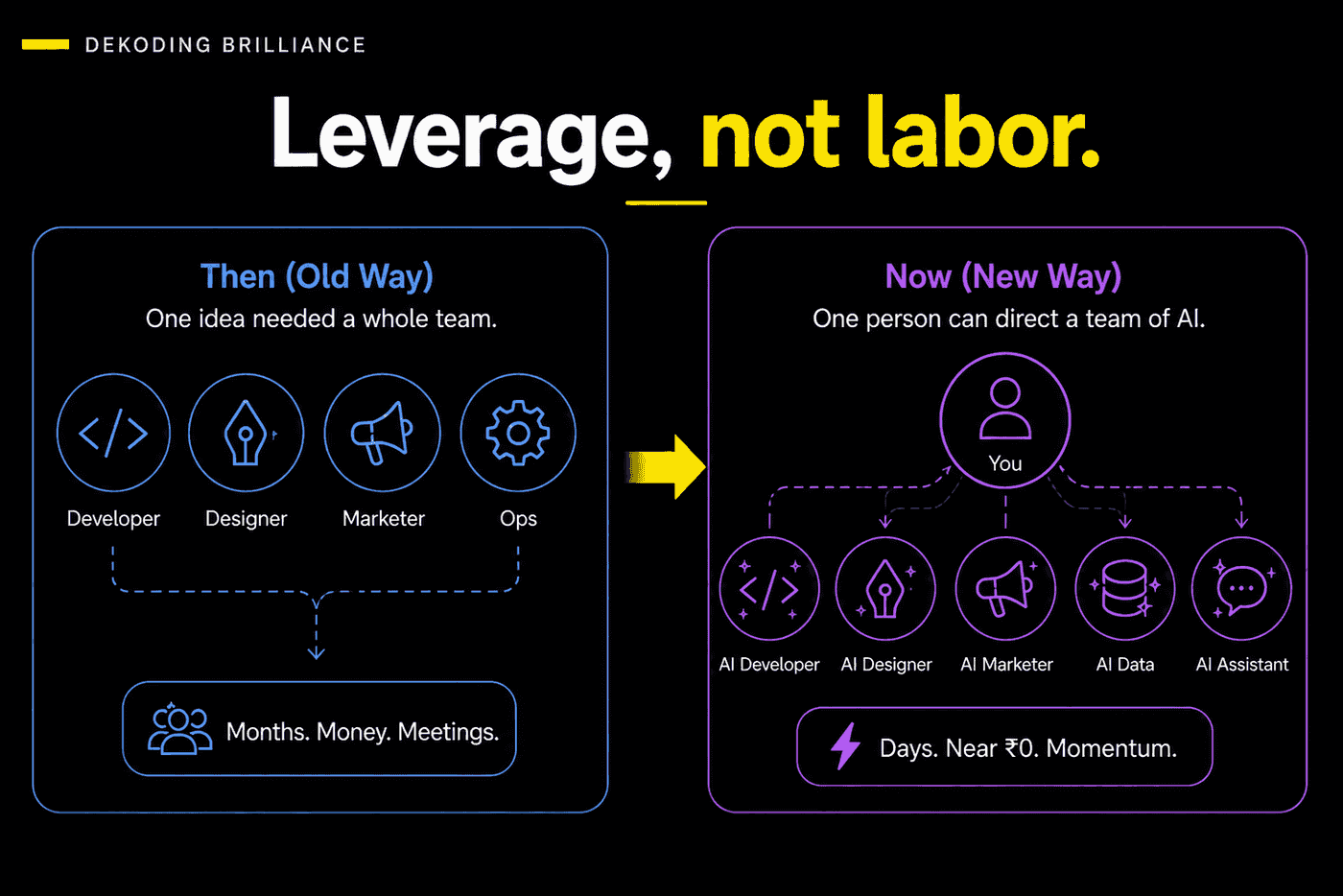
Direct a team you don’t have to hire.
Not long ago, turning an idea into a real product meant assembling people. A developer to build it. A designer to make it look good. A writer for the words. Someone to sort out payments. Four professionals at least, and money to pay them. If you couldn’t, your idea stayed an idea. That was the wall.
That wall is gone, and you might not have noticed yet. Today one student can direct four AI systems the way a founder directs a team. You describe what you want in plain words, and it gets built. You ask for a design, and it appears. You get stuck, and a patient tutor explains it. What used to need five people and three months now needs one motivated person and a weekend.
This is the real shift, and it’s bigger than any single tool. New tools will arrive every few months and the old ones will fade. The principle underneath won’t: you no longer need to be the whole team. You need to lead one. Your job is the part the machines can’t do, deciding what to build, for whom, and why anyone would care. That judgment stays yours. Everything else, you can direct.
And in India, it costs almost nothing to start. A domain is a few hundred rupees a year. Hosting is free. The AI tools have free tiers that get you surprisingly far. You can take payments through UPI in an afternoon. The old excuse, “I can’t build it,” isn’t true anymore. It just still feels true, because it used to be.
Try this (20 minutes): Take the tool from your weekend build and describe it, in one sentence, to an AI build tool. Watch a working first version appear in front of you. You don’t have to keep it. You just need to feel, once, how low the wall actually is now.
5. Prove
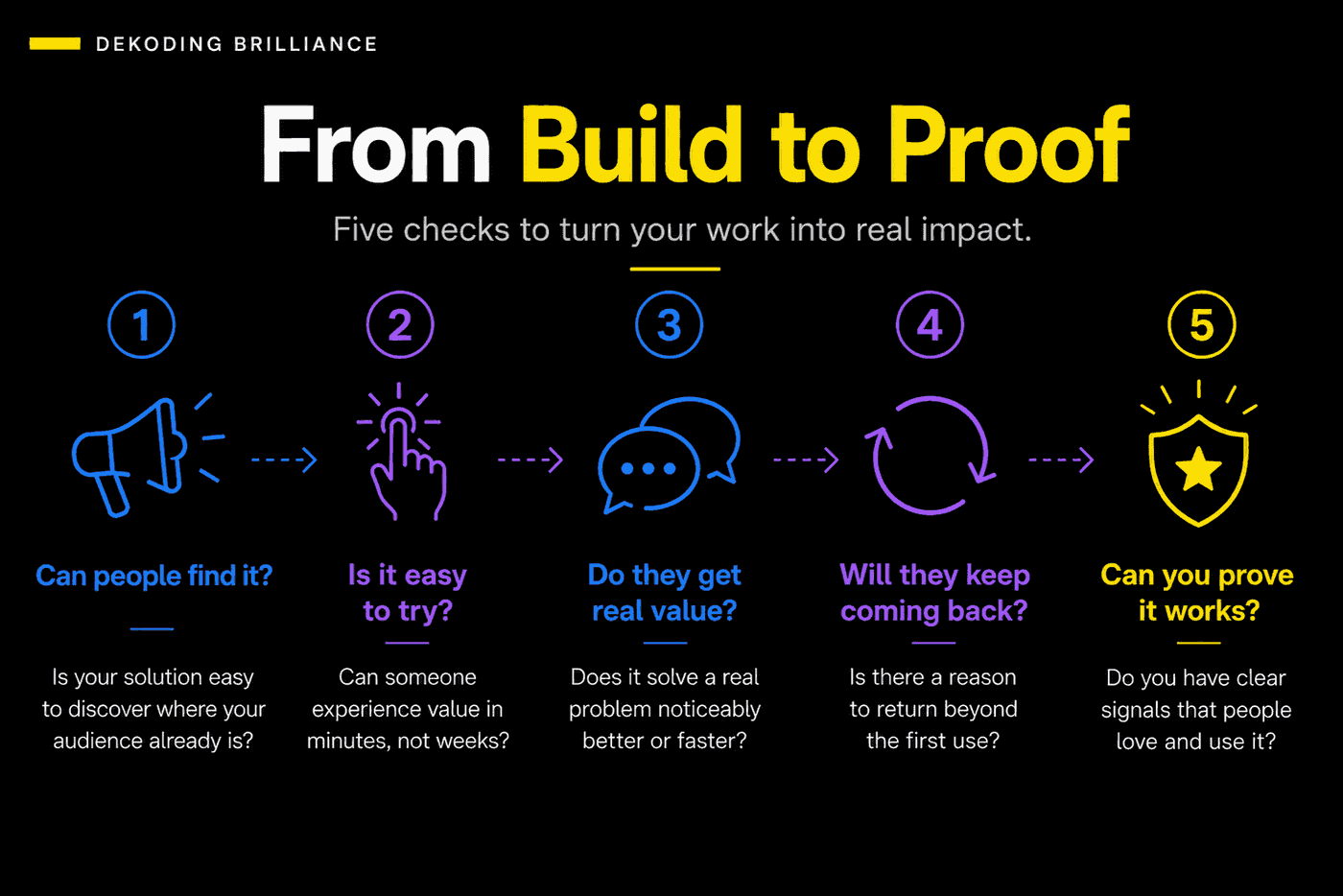
Show what you built. Don’t just say it.
This is the principle that matters most, because it’s about who you become, not only what you make.
Anyone can write “passionate about technology and entrepreneurship” on a form. Millions do. It means nothing, because it’s a claim, and claims are free. What almost nobody can do is send a link to a real, working thing that real people use. That’s evidence. And evidence is worth a hundred claims.
Picture it from the other side of a desk. An admissions officer reads ten thousand applications that all say the same ambitious things. Then one arrives with a link: a tool this student built, that a few hundred people actually use. Who do they remember? An investor, an employer, a mentor, they all run the same instinct. Talk is cheap. Proof is rare.
A project is evidence. An interest is just a statement.
So build to prove, not just to earn. Every ugly little tool you ship, every problem you solve for one small group, becomes real proof that you’re the kind of person who notices problems and builds solutions. That’s a reputation no certificate can hand you, because you can’t fake a thing people actually use.
Try this (ongoing): Start a single page called “Things I’ve built.” Every rough tool, every experiment, goes on it with a link. Most will be small. Some will barely work. It doesn’t matter. In two years, that page will say more about you than any list of grades, because it shows what you did, not what you claimed.
What this looks like when it’s real
Here’s what those five moves looked like when I tried them myself, mistakes and all.
It started with a frustration (Notice). Students spend years on their applications, then get a single rejection with no explanation. No feedback. Just a no. That’s a real, painful, everywhere problem.
So I built a small thing to fix one slice of it: a tool that reads a student’s application and tells them honestly where they stand, before they spend money applying. One clear job, not an everything-platform for admissions (Narrow).
Then I shipped it before it was ready, and this is the honest part (Ship). When I first put it live, I discovered it was quietly faking its own output. It looked like it was working. It wasn’t, really. I only learned that by shipping and poking at the real thing, never by planning.
And then a humbling moment. I sat in on a session by someone who does college admissions for a living, and walked out thinking: wait, is the way I’m scoring this even right? So I went back, checked my own guesses, and started fixing them. That’s not failure. That’s the loop. Ship, discover you were wrong about something, fix it, repeat.
The point isn’t that the tool is finished. It isn’t. The point is that it’s real. It’s live. People use it. And every wrong guess taught me something no amount of planning ever could (Prove). I didn’t invent it in a flash. I found a real problem and built proof, badly at first, then better.
You can do the same. Smaller, maybe. But the exact same five moves.
So what should you actually do next?
You don’t need a genius idea. Hopefully you’ve stopped waiting for one.
Here’s the whole guide in one breath: Notice a frustration. Narrow it to one small group who has it. Ship an ugly first fix this weekend, with AI as your team. Show it to five real people. Fix what confused them. Keep the link as your proof. Do that once and you’re already ahead of nearly everyone your age, who’s still waiting for permission.
Because that’s what this is really about, under all the business talk. Not startups. It’s this: you don’t have to wait. Not for permission. Not for perfect timing. Not for the day you finally feel ready. You can notice a problem today. Build something rough this weekend. Show it to real people next week. And slowly stack up proof that you’re someone who makes things happen.
That’s a bigger thing than starting a business. It’s a different way of seeing yourself.
Start today. Open a note. Title it “Ugh.” That’s the first move, and it’s free.
And if you want to do this properly, with people who’ll help you find the idea, talk to real customers, and ship something that works, that’s what The Builder’s Sprint is for. But you don’t need us to begin. You need a phone, a free afternoon, and one frustration worth fixing. You already have all three.
Go find the problem. The idea is hiding inside it.
FAQ
Do I need a genius idea to start?
How do I find a startup idea as a student?
Should I build for a big market or a small one?
How do I know if an idea is worth building?
Do I need to know how to code?
Why does a project matter more than saying I’m passionate?
Want to run the five moves with us?
The Builder’s Sprint is a 6-week program where you find a real problem and ship a real product. Twelve students a cohort.
Explore The Builder’s Sprint
Nimish · Founder & CEO
20+ years in product and growth, including scaling redBus from 500,000 to 5 million users. MBA from Thunderbird, and founder of Dekoding Brilliance, where he designs hands-on programs that teach high-schoolers to build, research, and think like operators.