INSPIRE Awards-MANAK is a Government of India programme for school students who come up with original ideas for solving real-world problems.
Every year, schools nominate student ideas. The strongest ideas receive ₹10,000 to develop a working prototype, and some eventually progress through district, state and national exhibitions.
The important catch: you cannot apply yourself. Your school has to nominate you.
And that is where this gets interesting.
Because there is no form you can fill. No app, no portal login, no way to post your idea to the Department of Science and Technology and wait.
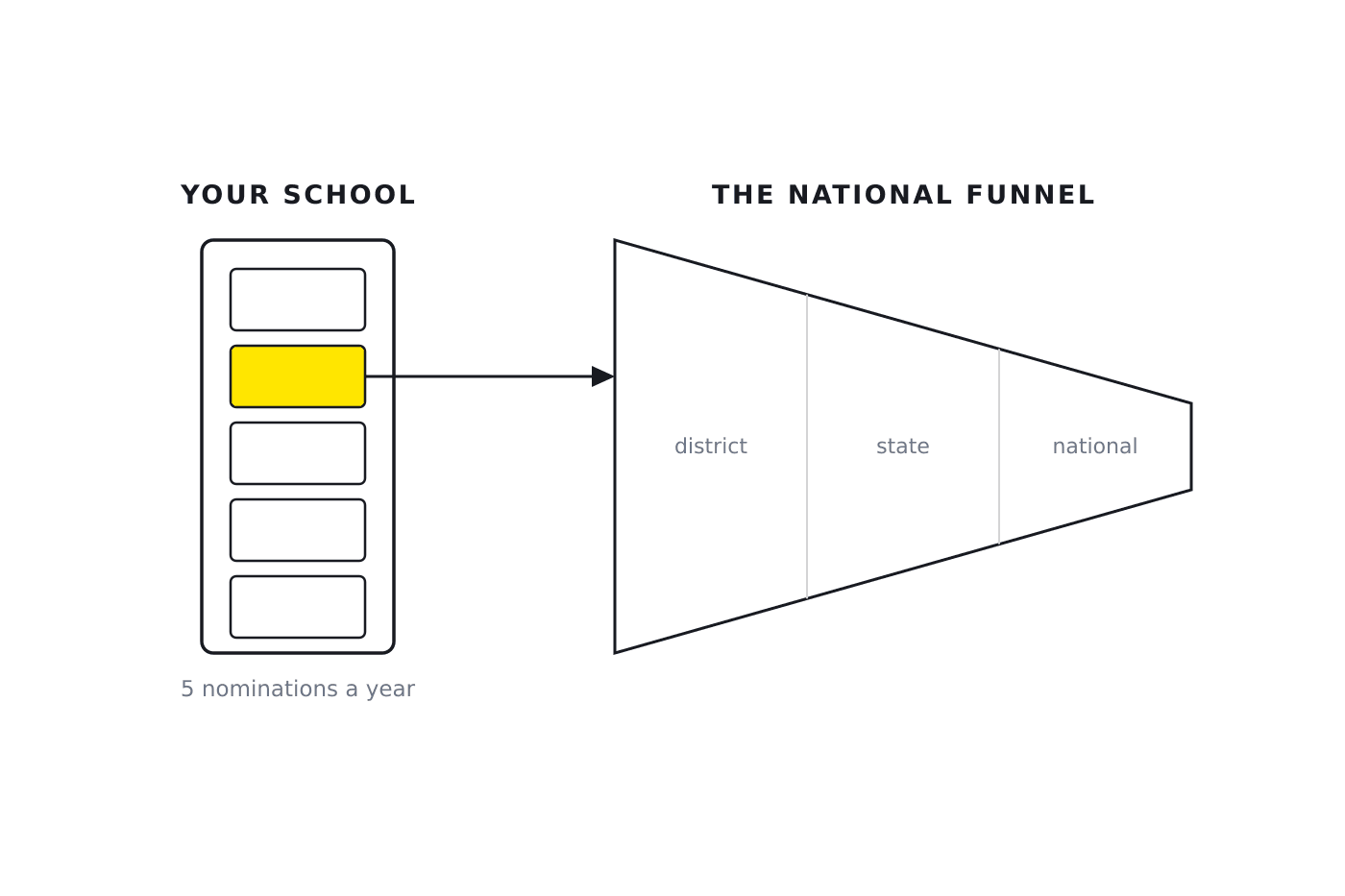
For INSPIRE Awards-MANAK, the nomination is made by your school. The principal or headmaster logs into the government portal using the school's U-DISE code and submits. The official FAQ puts it plainly: the principal calls for ideas, and the principal sends them in.
And the school gets five slots a year. Five, for the whole school. Of those five, at most two can come from classes 11 and 12, science stream only.
So the competition you have to win is not national. It is the person sitting two rows behind you.
Almost everything written about this scheme skips that step and goes straight to a list of two hundred project ideas. Which means almost everything written about this scheme is answering the second question while the first one is still open.
This is not a CBSE competition, and it is not a private one. It is a national programme run by the Department of Science and Technology, reaching students through participating schools of every board and every kind — government, private, state board, central board. CBSE schools are one part of that, not the whole of it.
If you are reading this in late August 2026, the first question has a date on it. Nominations for 2026-27 close on 15 September 2026 — a date carried in the circulars that went out to schools at the end of July, from CBSE and from state education departments alike. Your school's internal deadline, whatever it is, comes before that.
Go and ask, before you have the idea
I know how this sounds. You want to arrive with something brilliant.
But the sequence that actually works is the other way round, because the constraint is upstream of you.
Go and ask your science teacher or your principal three things.
Has the school nominated anyone yet this year. How many of the five slots are still open. And if you are in class 11 or 12, is either of the two science-stream slots free.
That conversation takes four minutes and it tells you whether you are competing for a place or asking a school to start a process it has not started.
One more thing you should know before that conversation, because most guides on the internet still have it wrong. Classes 11 and 12 became eligible from 2025-26. The Department of Science and Technology decided it in a notice dated 29 May 2025. Its own scheme page, at the time of writing, still says classes 6 to 10, ages 10 to 15. So does the Hindi version of the award portal. So do most of the listicles.
If a teacher tells you class 11 is not eligible, they are not being obstructive. They are reading a government page that was never updated.
What to do after this section
Before you write anything, ask your science teacher whether the school has used its five nominations this year — and if you are in class 11 or 12, whether either science-stream slot is free.
The list nobody links to
Now the ideas.
Somewhere on the portal's downloads page, unlinked from anything a student would ever reach, there is a four-page PDF called What kind of submissions will not be encouraged. You can download it from the government's site here.
It is the single most useful thing in this entire scheme and I have not found one ranking page that mentions it.
Here is what is on it, grouped the way the government groups it.
Water. Rainwater harvesting. Water purification and filtration. Water conservation. Wastewater treatment. Drip and automated irrigation. Hydroponics. River-cleaning boats.
Energy. Wind energy. Solar energy. Electricity from waste. Bio gas. Footstep power generation. Automatic energy-saving systems.
Smart home and city. Smart street lights. Home automation. Automated plant watering. Smart parking.
Safety and security. Burglar alarm. Fire alarm. Rain alarm. Earthquake alarm. Gas leakage detector. Smart railway crossing.
Models of the human body. Heart. Kidney. Respiratory system. Digestive system. Brain.
Science demonstrations. Photosynthesis. Potato battery. Electric circuit. Electromagnet. Satellite. Eclipse.
And the ones it says come back again and again. Smart helmet. Smart walking stick. Smart wheelchair. Women safety device. Health monitoring system. Washing machine.
Go and look at any "INSPIRE Award project ideas" page right now. You will find several of these on it. Some sites list two hundred and fifty ideas and include the rejected ones without a word of warning.
The document does add one caveat, and it is fair: an incremental improvement on these may still be considered if it is genuinely novel. So this is not a banned list. It is a list of things a judge has read a thousand times.
Download the list before you write anything
Open What kind of submissions will not be encouraged — a four-page PDF on the Department of Science and Technology's own site — and read your idea against it before you write a single line. We link the government's copy rather than hosting our own, because DST can change that file at any time and a copy sitting here would quietly go out of date.
Why those particular things fail
Look at the list again and ask what they have in common.
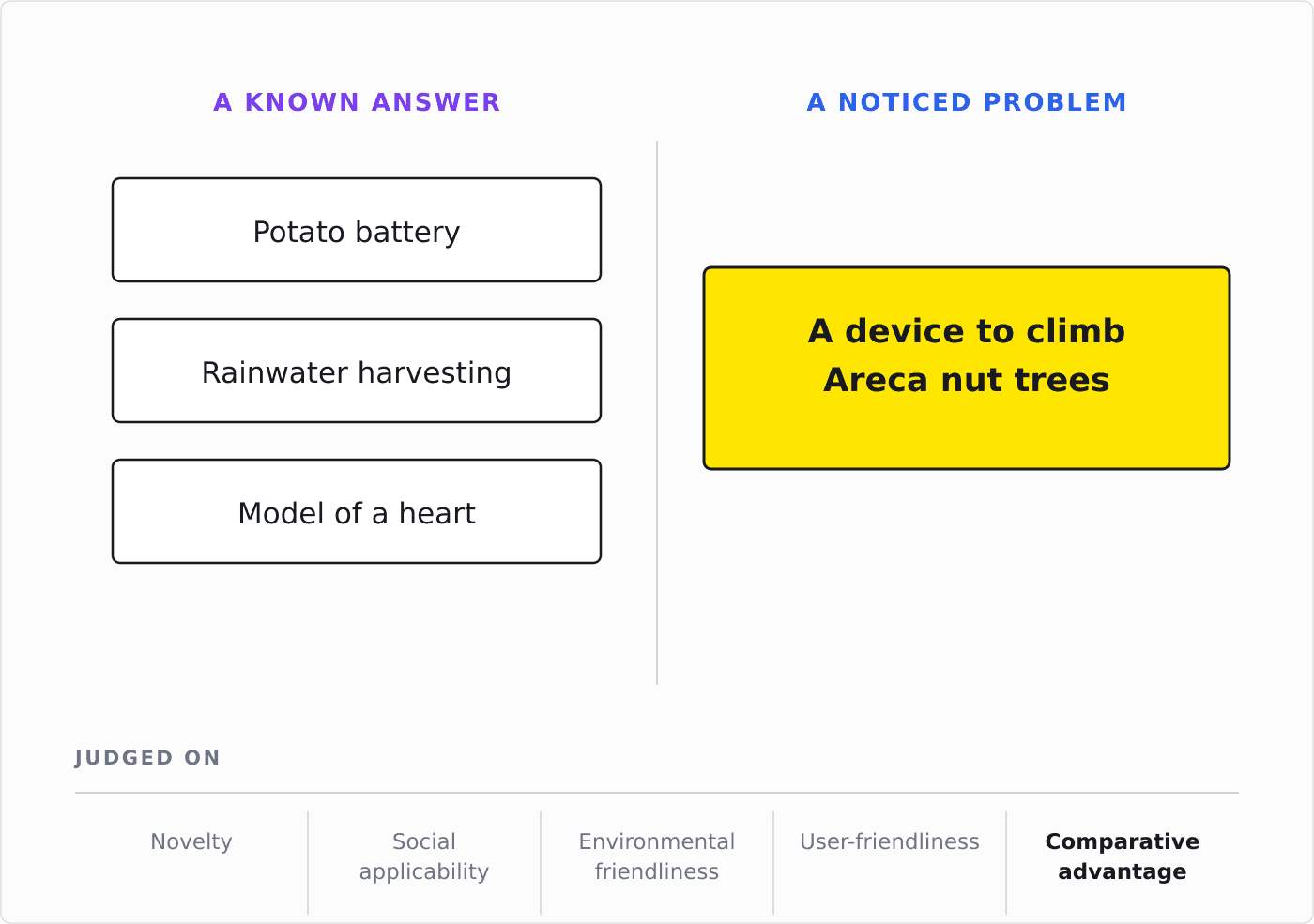
Every one of them is a known answer. A potato battery is a demonstration of a fact somebody already established. A model of a kidney is a model of a kidney. Rainwater harvesting is a solved technology that you are re-presenting.
What the scheme is asking for is different, and it says so in five words that are published on both the portal and the DST page.
The criteria are: novelty, social applicability, environmental friendliness, user-friendliness, and comparative advantage over existing technologies.
That last one is the killer, and it is the one nobody explains. Comparative advantage over existing technologies means the judge is going to ask what already exists for this problem, and why yours is better. A solar street light has no answer to that. It exists. It works. You have not improved anything.
Now look at the example the government itself gives, in its own guidance on writing a title:
A device to climb Areca nut trees.
That is it. That is the model answer.
It is not impressive-sounding. It is not national in scale. It does not have "smart" in the name. It is a specific, awkward, local problem that somebody actually watched happening, probably in coastal Karnataka, and it is the exact opposite of everything on the rejection list.
The thing that cannot be bought
There is an entire industry around this scheme now. Sites that sell pre-built working models, sensor kits, tested source code, consultation, and — this is the part I keep thinking about — report writing.
For an award whose whole premise is that the idea is yours.
And as far as I could tell from reading the scheme's own manuals, there is no originality check described anywhere. Judging criteria, yes. A mechanism for verifying that you thought of it, no.
So the incentives are unfortunate. Nomination numbers are rising fast — Uttar Pradesh went from 50,329 nominations in 2023-24 to 2,80,747 in 2024-25, which is not a story about teenagers suddenly becoming inventive, it is a story about a state administration pushing hard. Rising volume, a kit industry, and no verification. You can guess what a lot of the pile looks like.
Which is oddly good news for you.
We looked at this in a different context earlier this month. We read 100 real cases of teenagers who found a problem worth solving and looked for one sentence in each: where did the problem come from. Among the ones who posted their own work, 50% found it in their own life. Among the ones written up by press and award programmes, that number was zero.
We wrote at the time that this is not a fact about teenagers, it is a filter on who gets written about. Award programmes reward problems that sound worthy — a farmer's problem, a village's problem, a disabled person's problem — and quietly filter out the ones that start with this annoys me.
Here is the thing though. Look at that areca nut tree again.
Somebody's family climbs those trees. That is a problem from their own life. It just happens to also be a real one.
The gap between "an idea that scores well" and "a problem you actually noticed" is smaller than the listicles make it look. What the scheme is filtering out is not personal problems. It is generic ones.
DB Insight
The scheme is asking for the one thing that cannot be bought — a problem you noticed yourself — and the entire market around it is selling substitutes.
You will not be in the room
There is a line in the government's own guidance on writing your entry that you should read twice:
"All ideas are initially screened online, without the student being present to explain the idea or innovation."
Nobody will ask you a follow-up question. There is no viva at this stage. Somebody who has never met you reads a few lines on a screen with several hundred others in the queue.
That makes the write-up — the synopsis — the entire thing.
The official guidance says it must cover three things: what the idea is, the problem it addresses, and the advantage or benefit it offers.
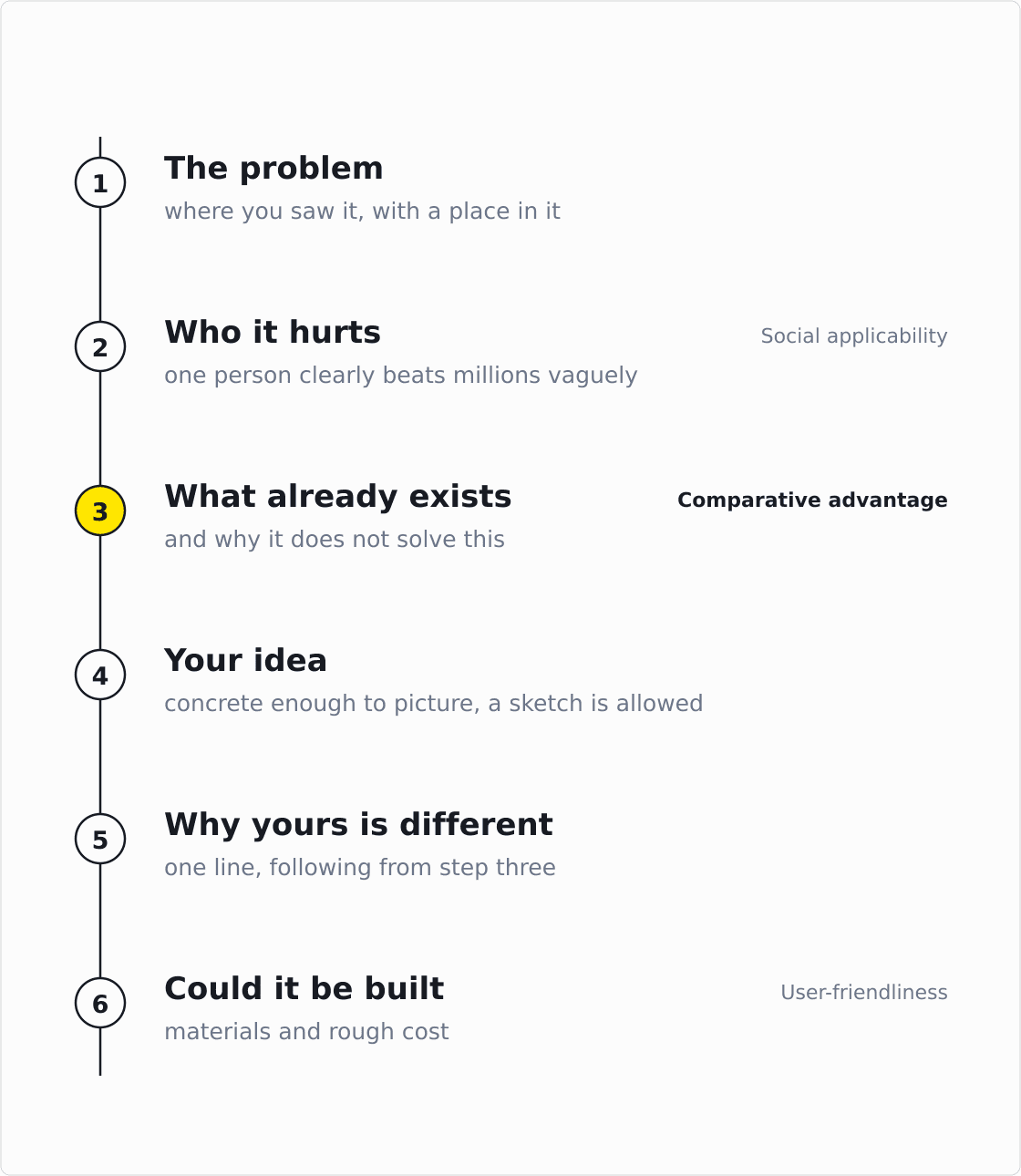
That is a good skeleton but it is thin, so here is a fuller version that maps onto the five criteria the judges are actually using.
One. The problem, in a sentence, with a place in it. Not "farmers face difficulties." Something a person could picture. Where did you see it.
Two. Who it hurts, and how often. This is the social applicability criterion. One person, badly, is fine. Vague millions is not.
Three. What already exists, and why it does not solve this. This is comparative advantage, and it is the section almost nobody writes. If you skip it, the judge fills it in themselves, and they will fill it in against you.
Four. Your idea, described concretely enough to be pictured. A sketch is allowed. Use one.
Five. Why yours is different. One line. It should follow directly from point three.
Six. Whether it could actually be built. Materials, roughly. Cost, roughly. This is user-friendliness and it is where an over-ambitious idea quietly loses.
Two rules on the title, from the same official guidance. Make it describe the actual thing — A device to climb Areca nut trees, not Innovation in Agriculture. And avoid the broad theme words: Agriculture, Swachh Bharat, Swasth Bharat, Digital India. Those are categories, not ideas.
And you do not need a working model at this stage. The Hindi searches around this scheme split almost evenly between kaise likhen — how to write it — and kaise banaen — how to build it. At nomination, the answer is write it. The building comes later, and it comes with money.
One more rule people miss because it sits only in the FAQ: individual students only. Not teams. You cannot do this with a friend.
And a rule that runs the other way, which almost nobody knows: the FAQ says ideas may be submitted in any of the 22 languages of the Eighth Schedule. If you have been told your English is not good enough for this, that is worth checking. I will add one honest caveat — the school-side manual that the principal actually types into instructs the school to write the synopsis in English. We could not reconcile those two documents. Ask before you assume either way.
The numbers, honestly
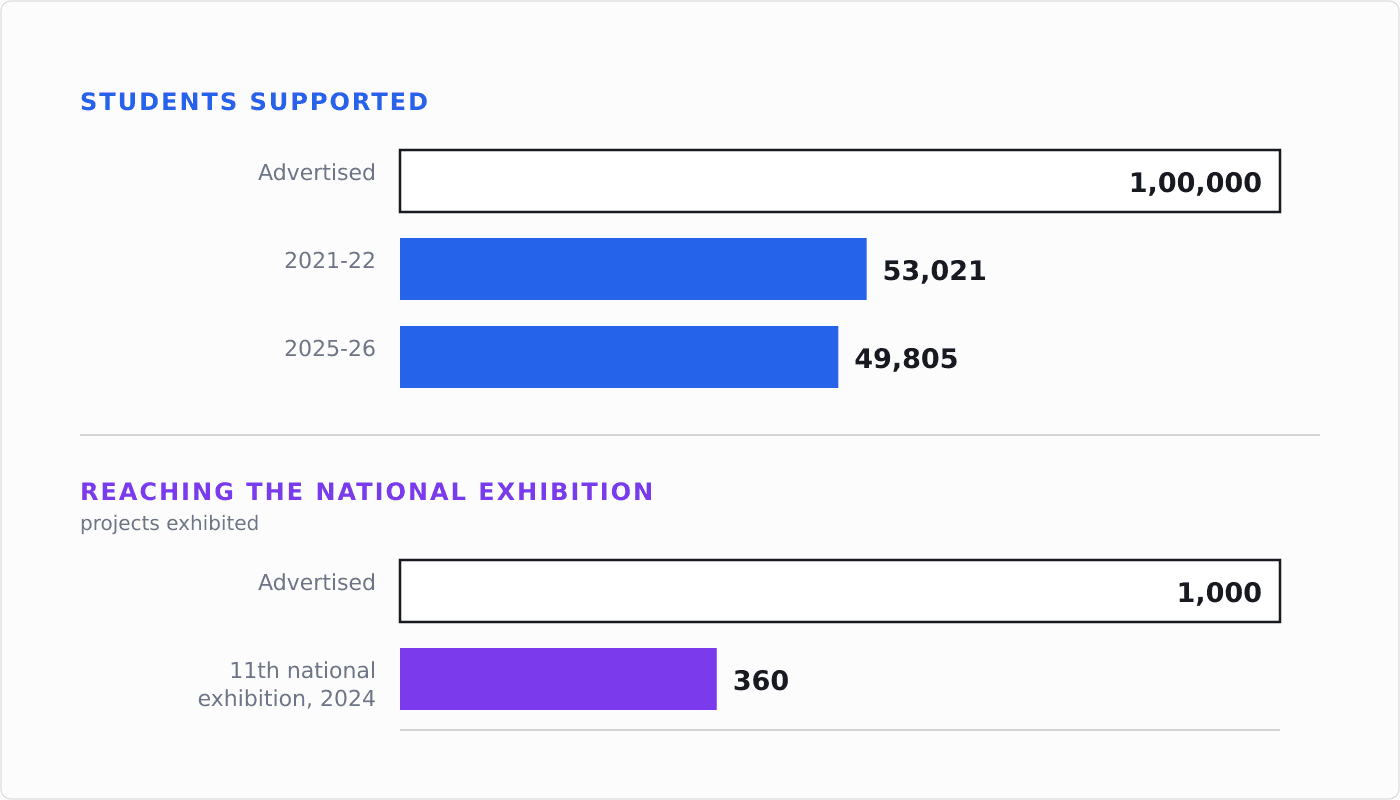
You will see the same funnel on every page about this scheme. Ten lakh ideas targeted, one lakh shortlisted for ₹10,000, ten thousand to district level, a thousand to national, top 60 awarded.
That is a design document. It is not what happens.
In 2021-22, on 6.53 lakh nominations, 53,021 students were supported. In a written reply to the Lok Sabha on 22 July 2026, the Minister said that during 2025-26, 49,805 students were supported under INSPIRE-MANAK.
Roughly half the advertised figure, in both years I could verify.
Meanwhile nominations have gone up sharply. Ten states alone filed more than 9.4 lakh in 2024-25. I cannot give you a national total, because I could not find one published anywhere for the last three years — so treat what follows as my arithmetic, not a government statistic. Against roughly fifty thousand awards, a nomination in that year looks closer to a 4% or 5% chance than the 10% the design ratio implies.
The national stage is smaller than advertised too. The eleventh national exhibition displayed 360 projects, not a thousand. Thirty-one students were felicitated, not sixty.
I am not telling you this to flatten your enthusiasm. I am telling you because you will read the other number somewhere and plan around it.
And there is one number in the other direction that I think matters more than any of these. At that eleventh national exhibition, first place went to Deepak, class 10, Government High School Udotgarh, Madhya Pradesh, for a distance sensor built into a phone to protect eyesight. Third place went to Amulya Hegde, class 9, at a government PU college in Karnataka, for a flood-detecting pole.
This is not a scheme won by expensive schools. 84% of participation in 2021-22 came from rural schools, 71% from government schools, and just over half of participants were girls.
If you go to a well-resourced private school, understand what that means: you have no particular advantage here, and you have other doors open to you that most of the field does not.
The ₹10,000 is not a prize
If you are shortlisted, ₹10,000 arrives in a bank account by direct transfer.
It is not a reward for winning. The FAQ is explicit: it covers the cost of making the model, and the cost of bringing that model to the district-level exhibition. The money is disbursed around August. The district exhibition is around September.
The money comes before the work. It is a grant with a job attached.
And the job does not always get done. The scheme's own manual concedes that not all students who receive the ₹10,000 take part in the district exhibition. In Bihar in 2022-23, according to a Rajya Sabha reply of 24 July 2025, 3,407 students were awarded, 2,648 turned up at the district exhibition, around 210 reached state level, and 16 made it to the national one.
Roughly one in five took the money and did not come.
I do not think most of them were free-riding. Ten thousand rupees has to cover a working prototype and a family's travel to a district headquarters, and it lands one month before the event. If you get shortlisted, plan that trip on the day the money arrives, not the week before.
There is one boring thing that will decide whether you see the money at all. The name on your bank account must match your school records exactly. Joint accounts with a parent are allowed. Mismatches fail often enough that the government runs a permanent page for checking payment status and fixing bank errors — and when a payment fails, the notification goes to the school's email, not to you. So if the money has not arrived, do not wait quietly. Go and ask.
Two doors nobody is guarding
Here is the part that would be dishonest to leave out.
INSPIRE is the only opportunity in this space that you cannot enter yourself. There are others that need nobody's permission.
| Route | Who applies | Cost to enter | Where it can lead |
|---|---|---|---|
| INSPIRE MANAK | Your principal | Free | District, state and national exhibitions |
| IGNITE | You | Free | Support with patent filing |
| IRIS National Fair | You | ₹5,000, waiver available | Selection to the international science fair |
| NCSC | You, with a guide | Free | State and national congress |
IGNITE, run by the National Innovation Foundation — the same organisation that runs INSPIRE's technical side — takes entries directly from students up to class 12. It is free. And it supports patent filing at no cost to the student.
IRIS National Fair lets a student self-nominate, costs ₹5,000 with a waiver available, and is India's route to the international ISEF.
The National Children's Science Congress accepts children who are not enrolled in school at all.
Worth knowing: Vinisha Umashankar, probably the best-known Indian teenage innovator of the last few years, is often described as an INSPIRE success story. Her documented route was the self-nominated one — the IGNITE award, and the Children's Climate Prize in 2020, with NIF engineers building her prototype in Ahmedabad.
So the honest advice is not "apply to INSPIRE". It is this: enter the ones that do not need permission, and ask for the INSPIRE slot as well. Three attempts, only one of which depends on somebody else saying yes.
What you actually have to answer
Strip all of it away — the portal, the funnel, the five criteria, the exhibition — and one question is doing all the work.
What did you notice, and who does it hurt?
That is what a stranger is reading on a screen without you in the room. It is what a solar street light cannot answer and a device for climbing areca nut trees answers in six words.
You cannot buy it. No kit contains it. Nobody can write it for you, because it did not happen to them.
And here is what I keep coming back to. The thing you need is not a bigger idea. It is ten minutes of paying attention to something ordinary and irritating that everyone around you has stopped seeing. It is the same move we set out in why good ideas are found, not invented.
Then you go and ask your teacher whether the school still has a slot free.
In that order.
This is the kind of thinking we care about at Dekoding Brilliance: not giving students answers to copy, but helping them learn how to notice problems, investigate them and build something useful. Which is why this article does not contain a list of project ideas, and never will.
What have you already noticed this week that you assumed was too small to count?
What next? Are you ready to dive in
This page can tell you what makes an idea worth nominating. It cannot stand next to you while you build the thing. The Builder’s Sprint is a six-week programme where twelve students take one idea from a blank page to something people can actually use.
Explore The Builder’s SprintEvery official document cited here was opened and checked on 27 August 2026, on the INSPIRE Awards-MANAK portal, the Department of Science and Technology scheme page, and PIB records of replies given to the Lok Sabha on 22 July 2026 and the Rajya Sabha on 24 July 2025. Dates and rules change between cycles — check the portal before you rely on any of them.
FAQ
Can I apply for the INSPIRE Award myself?
When is the last date for 2026-27?
I am in class 11. Am I eligible?
Do I need a working model to be nominated?
Is the ₹10,000 a prize?
Can two of us submit an idea together?
Can I write my idea in Hindi?
What are my chances?
What we know, what we don't know, and what we're not going to pretend
Everything above was checked against the government's own documents. Some of it could not be checked at all, and rather than smooth over the gaps, here they are.
- The national nomination total for 2023-24, 2024-25 or 2025-26. It does not appear to be published anywhere. Our estimate of a 4% to 5% chance is arithmetic on a partial list of state figures against a verified award count, and should be read that way.
- Whether ideas submitted in Indian languages are processed on equal terms. The provision is real in policy. The manual the school types into says English. We found no evidence either way about what happens in practice.
- Whether the scheme works over time. We could not find a CAG audit, an independent impact evaluation, or any published outcome data on what happened to past awardees. The portal runs a voluntary questionnaire asking winners since 2009-10 what became of them, and has published no results. By contrast, Atal Innovation Mission commissioned and published an independent assessment of Atal Tinkering Labs, uncomfortable findings included.
- The definitive year-by-year award figures. The portal has interactive tables going back to 2009-10, but they load through a dropdown we could not read.

Nimish · Founder & CEO
20+ years in product and growth, including scaling redBus from 500,000 to 5 million users. MBA from Thunderbird, and founder of Dekoding Brilliance, which designs hands-on programs teaching high-schoolers operational, building, and research skills.