Three years ago I told people the secret was silence
I meant it.
I had sat in an ashram in Lonavala. I put my phone away for weeks. Ideas came. So in September 2023 I published an article saying the biggest secret to new ideas is silence.
Then we did the work.
We read 100 cases of people who actually built something. Fifty nine adults. Twenty nine teenagers. Twelve Indian companies. In each one we looked for a single sentence. Where did the problem come from?
Not one of them said silence.
Not one of them said a list.
Not one of them said market research. Not one in a hundred.
Every single one of them was standing somewhere, near a person, watching that person have a bad time.
So I was half right. Silence is where you sort out what you saw. It is not where you see it.
Asking gives you wishes. Watching gives you problems.
You can check this yourself in about ten minutes.
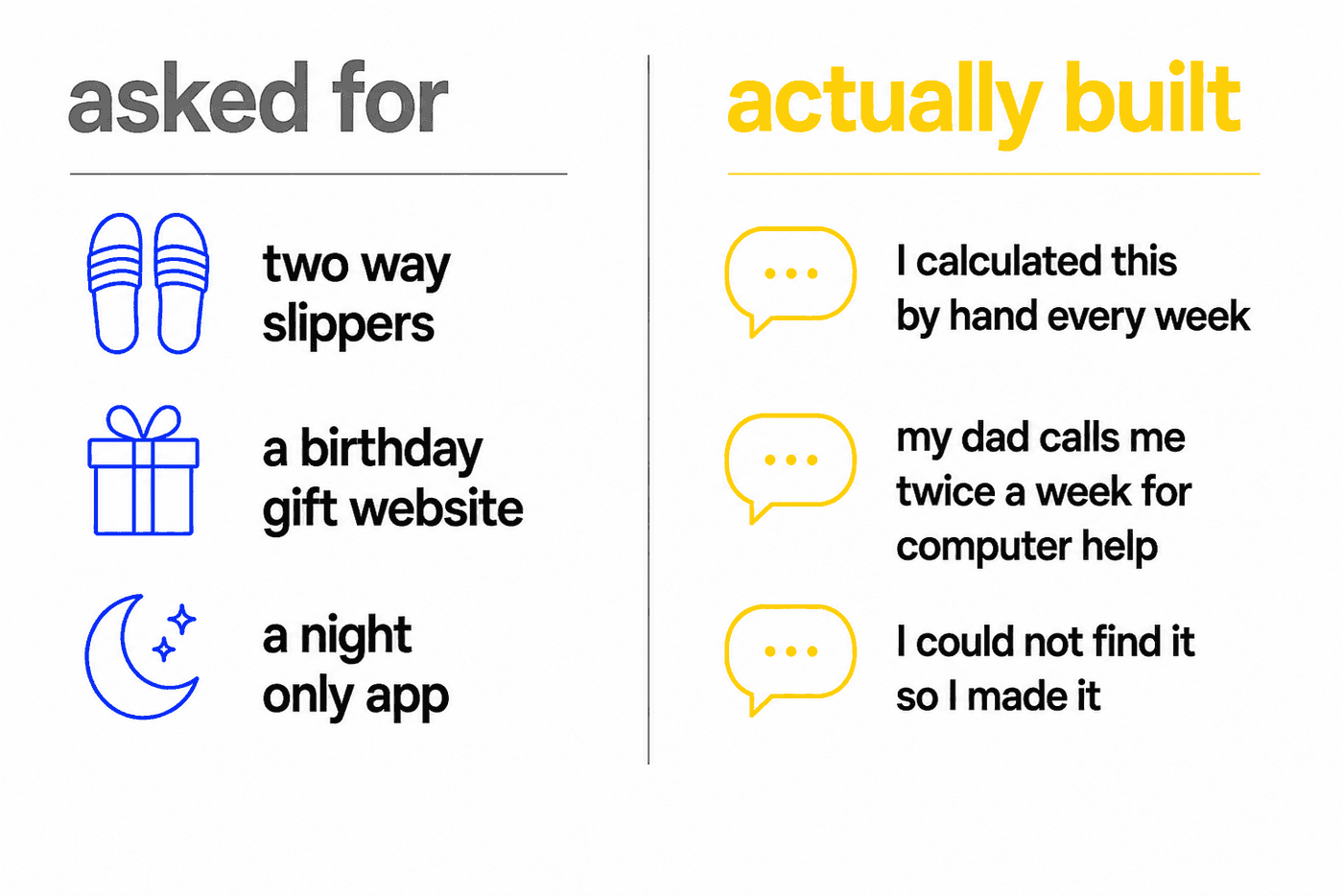
There is a corner of Reddit where people post ideas for somebody else to build. Nobody there builds anything. They are asking. Their most popular posts of the year include a website where strangers send each other birthday gifts, an app that only exists at night, and the most toxic app ever made.
Now go to a site called Hacker News. It has a section where people post things they have already finished building, and say why they built them.
Those reasons are never fantasies. I kept having to calculate this by hand. My dad calls me twice a week for computer help.
Two groups of people. Same internet, different outcomes. One group is making wishes. The other has already shipped something.
The difference is not talent. It is the question each of them started with. One asked what somebody should make. The other noticed something that kept annoying them.
Someone to walk through this with you. I am going to invent one student and keep her with us to the end. Her name is Diya. She is sixteen, in Class 11, in Pune, and she wants to build something this year.
Diya is not real. Everything she notices in this article is. Every single thing she spots was taken from one of the hundred cases. I am not going to give her a company, a prize or a happy ending, because I do not have one to give her honestly. She only ever notices things. That is the point.
What to do after this section
Stop asking people for ideas this week. Not your friends, not Reddit, not ChatGPT. You are going to watch instead.
Adults have jobs, you do not, and that is the whole problem
Read this section twice. It is the reason every article you have found on this subject was useless to you, and it is not your fault.
Start with Diya on a Sunday afternoon.
She searches how to find a startup idea. She finds a good article by a popular person. It tells her to look for problems in her daily work. To notice what she complains about at her job. To watch her team waste time.
Diya does not have a job, a team or a workflow. She has school, tuition and boards in eighteen months.
So she closes the tab and decides she has nothing worth noticing.
Now the numbers, because this is not a feeling.
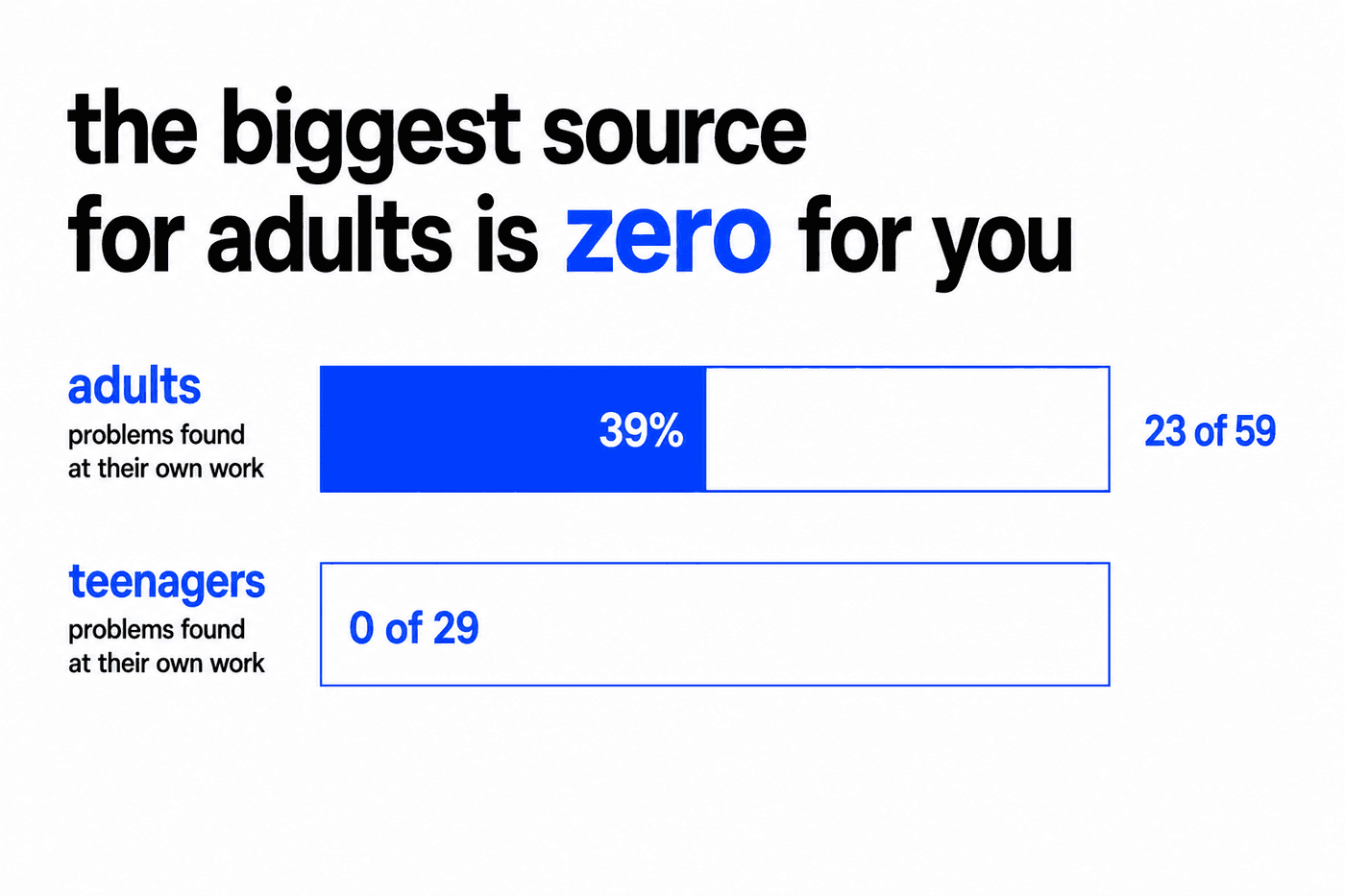
I counted where the adults in our set found their problem. The single biggest place was their own work. Twenty three of fifty nine. Thirty nine per cent.
Then I ran the same count on the twenty nine teenagers, expecting a smaller number.
Their own work. Zero.
Not one. Not a single teenager in the set found their problem at a job, because they do not have one.
You cannot look around a job you do not have.
That single sentence disqualifies almost every piece of advice on this subject.
What replaces a job
School.
School is your unpaid workplace. Six hours a day. Tools you did not pick. No way to change them when they are bad.
Six of our nine school cases say the same thing. The tool my school makes me use is bad. Two of them are worth telling properly.
A sixteen year old had to pull quotes out of thirty page PDFs for his assignments. He would scroll for hours looking for one line. He tried Ctrl+F. He tried highlighting. In the end he printed the whole thing out on paper. Then he went and built something to fix it.
An eighteen year old could not hold anything in her head by reading her revision notes. So she started recording herself reading them out loud, and playing the recordings on the bus and the train, again and again. After a while she began sending those recordings to her friends.
She built a product, on a bus, without noticing she had.
Here is the thing that surprised me most. Adults and teenagers notice the same things in almost the same proportions. Repetition and could not find are the top pair for both groups. For adults that pair is 33 of 59. For teenagers it is 13 of 29.
You notice the same things a thirty year old notices. You are just standing somewhere else.
| Where they found the problem | Adults, 59 cases | Teenagers, 29 cases |
|---|---|---|
| Their own work | 39% | 0% |
| Their own life | 17% | 31% |
| Their school | 14% | 31% |
| Their family | 24% | 21% |
| A local business | 2% | 14% |
What to do after this section
Take any advice you have saved about finding ideas. Cross out the words your job. Write in school. Now it works for you.
Five things to watch for
A man stood in a workshop watching his father cut window profiles. Measuring by hand. Repositioning by hand. Hundreds of times a day.
That is repetition, and he found it without a framework.
I started this research with a list of twelve things to watch for, and I was quite pleased with it. I cut it down to five.
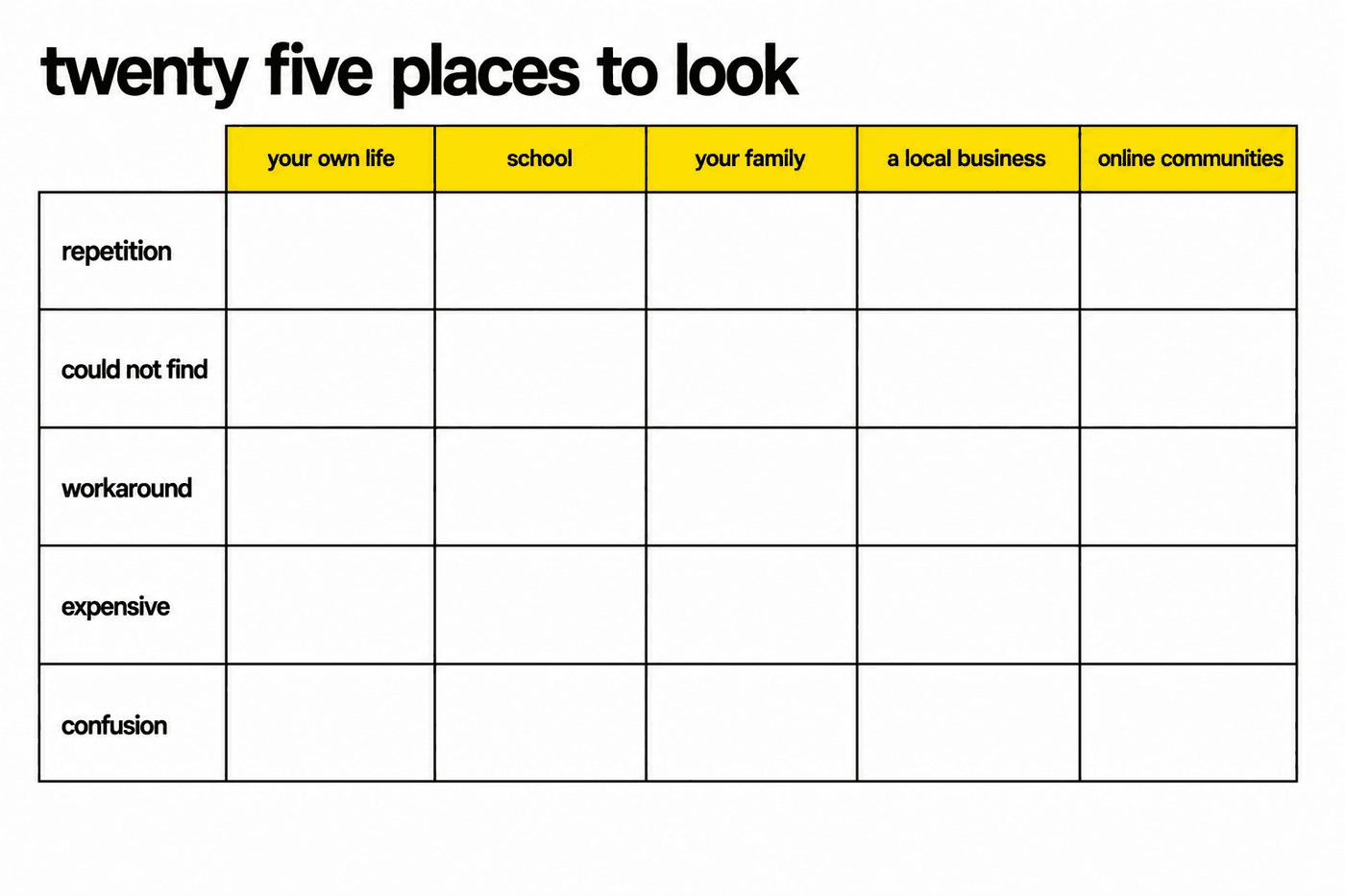
1. Repetition. Pay attention and you will notice the same annoying thing happening over and over again. It is how 19 of 59 adults and 7 of 29 teenagers found the problem they worked on.
2. Could not find. Somebody went looking for a thing and it was not there. The Zepto founders put it plainly: “It was incredibly difficult for us to get groceries.” 14 of 59 adults said something confused them, and 8 of those 14 were really this. It is the easiest one for you to act on, because searching for something and failing takes ten minutes.
3. Workaround. Somebody built a clumsy thing to survive the problem. 13 of 59 adults. The next section is entirely about this one.
4. Expensive. It costs more than it should, or more than the person has. 8 of 59 adults. A fifteen year old noticed it the day his study app put its main feature behind a paywall.
5. Confusion. Somebody does not understand a thing they are forced to use. “My dad often struggles with using his computer and calls me multiple times a week to ask for help.”
What to do after this section
Pick one thing to watch for. Just one. Watch for only that one for a week.
Five places to stand
On Saturday morning Diya walks past the tailor she has used since she was nine.
She has walked past him maybe four hundred times. Today she goes in, sits on the plastic chair, and stays for twenty minutes without asking him a single question.
The five things above tell you what to watch for. These five tell you where to go and stand.
Your own life. The things that annoy you when nobody is watching.
Your school. Six hours a day of tools you did not choose.
Your family. Watch what your parents do slowly, or twice, or with a calculator.
A local business. The tailor. The chemist. The gym. The tuition centre.
Online communities. Useful for checking a problem is real. Weak for finding one.
Four of those will feel obvious to you. The shop will not. And the shop is the biggest thing I found.
In the fifty nine adult cases I read, a local business was the source once. One in fifty nine. Those are adults with office jobs. They stand in an office, so they see office problems.
An American founder stands in an office. An Indian founder stands in a shop.
Three of India’s fastest growing companies began at a counter like the one Diya is sitting at. Dukaan began when a shopkeeper sent its founder a PDF catalogue over WhatsApp to sell clothes (Forbes India). Khatabook began at a paper ledger, and its founder was careful to say “we were mindful not to change the style of maintaining the bahi khata” (YourStory).
The third one went further than looking. Meesho’s founder took a delivery job himself, “because I wanted to hear my customer’s feedback first hand” (YourStory).
Nobody in the entire adult set did what Diya just did. They could not. They were at work.
You can. You have a tailor, a chemist, a gym and a canteen within walking distance, and you have a free Saturday. That is the one place you can go that a working adult cannot, and it is the same place these companies came from.
Two honest exceptions, because watching is not the only route.
Ather did not come from watching anyone. Its founder says so plainly: “we were building a scooter on the side to put that battery pack on and we fell in love with the scooter.” (Business Today)
CRED came from a question rather than a person. Kunal Shah asked why trust cannot be rewarded.
Watching is the route that works most often. It is not the only one.
What to do after this section
Pick one place. Go there this Saturday. Stand still for twenty minutes and observe.
The spreadsheet is the evidence
the spreadsheet is the evidence
Twenty minutes into Diya’s visit, the tailor reaches under the counter for a school notebook, wrapped in brown paper, with names and measurements written in columns.
He never complains about it. He is rather proud of it.
That notebook is the most valuable thing in the shop, and she almost did not notice it.
Of the thirteen adult workaround cases in our set, eight named a spreadsheet and four named a WhatsApp group. Nothing else came up even twice. One man had reached column XE of a Google Sheet, which is 657 columns, before he finally built the app. One family kept its entire medical history as WhatsApp photos of lab reports.
Now here is the part that flips the advice I have given people for years.
A workaround is a complaint that stopped talking.
People do not complain about a problem they have worked around. They already fixed it badly, moved on, and stopped noticing. Ask the tailor what is hard about his day and he will say nothing is hard. The notebook is doing its job.
So listening for complaints finds you the loud problems, which are the ones everybody has already heard. Looking for the clumsy object finds the quiet ones, and quiet is what makes them still available to you.
In India the object is older than a spreadsheet and the scale is enormous. Of India’s unincorporated enterprises, 0.87% keep audited accounts and 5.5% use a computer. That is the government’s own survey of 5.23 lakh enterprises (MoSPI).
That is the tailor’s notebook. It is not a niche. It is nearly the whole informal economy.
So the rule is simple, and you can test it on Monday. When someone says I use Excel for, or we made a WhatsApp group for, or you see a paper register on a counter, that is software nobody has written.
An object like that is proof somebody already paid for this problem with their own time.
What to do after this section
Stop listening for complaints. Start looking for the clumsy object.
The trap that will make you throw away your best idea
the ones who shipped started with themselves
That evening Diya writes down the notebook. Then she writes down something else, and immediately crosses it out.
The second one was hers. Her school circulates exam timetables as images on WhatsApp, and she has missed two changes this year because the image scrolled past.
She crossed it out because it felt too small.
Do not cross it out. Here is why.
I found those twenty nine teenagers in two different ways. Eighteen of them I found because they had posted their own project online. The other eleven I found because a newspaper or an award programme had written about them.
Then I split the two groups, expecting nothing, and the result made me uncomfortable.
| Where they found the problem | The 18 who posted their own work online | The 11 who got written about by the press |
|---|---|---|
| Their own life | 50% | 0% |
| Their family | 6% | 45% |
| Local community | 6% | 27% |
Read those two columns again.
Teenagers who built and shipped something said the problem was theirs. My acne. My AirPods. My folders. My bike routes.
Teenagers in award write ups said the problem was somebody else’s, almost always a grandparent or a farmer.
That is not a fact about teenagers. It is a filter on who gets written about. I was annoyed my AirPods did not work properly on Android does not win a national award.
And here is how it does its damage to somebody like Diya. She goes looking for examples. She finds the award profiles, because those are the ones that get covered. She concludes a real problem has to belong to someone else, and ideally be a serious one. So she throws away her own irritation and starts looking for a stranger to help.
The teenagers who actually shipped things started with their own irritation.
One more thing I found while checking this. India runs large schemes to fund student innovation, and they publish shortlists, district counts and equipment lists. They do not publish what the student noticed. We celebrate student innovation in this country without ever recording how it starts.
What to do after this section
Write down the thing that irritated you this week. Do not upgrade it into something noble.
The rule is written down, now go and measure the real thing
Diya’s school has a stated rule that timetable changes go out two days in advance. She starts a note on her phone and logs every change for three weeks.
Nine changes. Four of them arrived on the same day.
Now she is not a student with an opinion. She is a student with a count.
I have never seen this one in a book. It works especially well in India.
Find a rule that somebody wrote down. Then go and count what really happens.
The space between the two is your problem. And it comes with a number.
Two real examples, both bigger than a timetable.
Health insurance. The insurance regulator’s 2024 circular says cashless approval in one hour and discharge in three hours. In a large public survey, six in ten claimants said they waited between six and forty eight hours (reported here, survey by LocalCircles, which is an online panel people opt into, so treat it as an indication and not a census).
Your teachers. Section 27 of the Right to Education Act allows teachers to be pulled off teaching for exactly three things: census, disaster relief and elections. In practice they run admission help desks for a month a year and fill roughly ten separate government portals, typing the same information into each one in a different format (Careers360).
You are sixteen, and adults do not take your opinion seriously yet. I know that is annoying and I am not going to pretend otherwise. A number fixes that faster than anything else I know. It does not have to be clever. Just show them the rule. Then show them what you counted.
What to do after this section
Find one written rule in your own world. Exam result timelines. Library return rules. Bus timings. Count what really happens for two weeks.
How to know if it is real, and what to do this week
Diya has two things now. A tailor’s notebook and a count of nine.
She still does not know if either is real. Here is how she finds out, and she can do it without asking anybody for a favour.
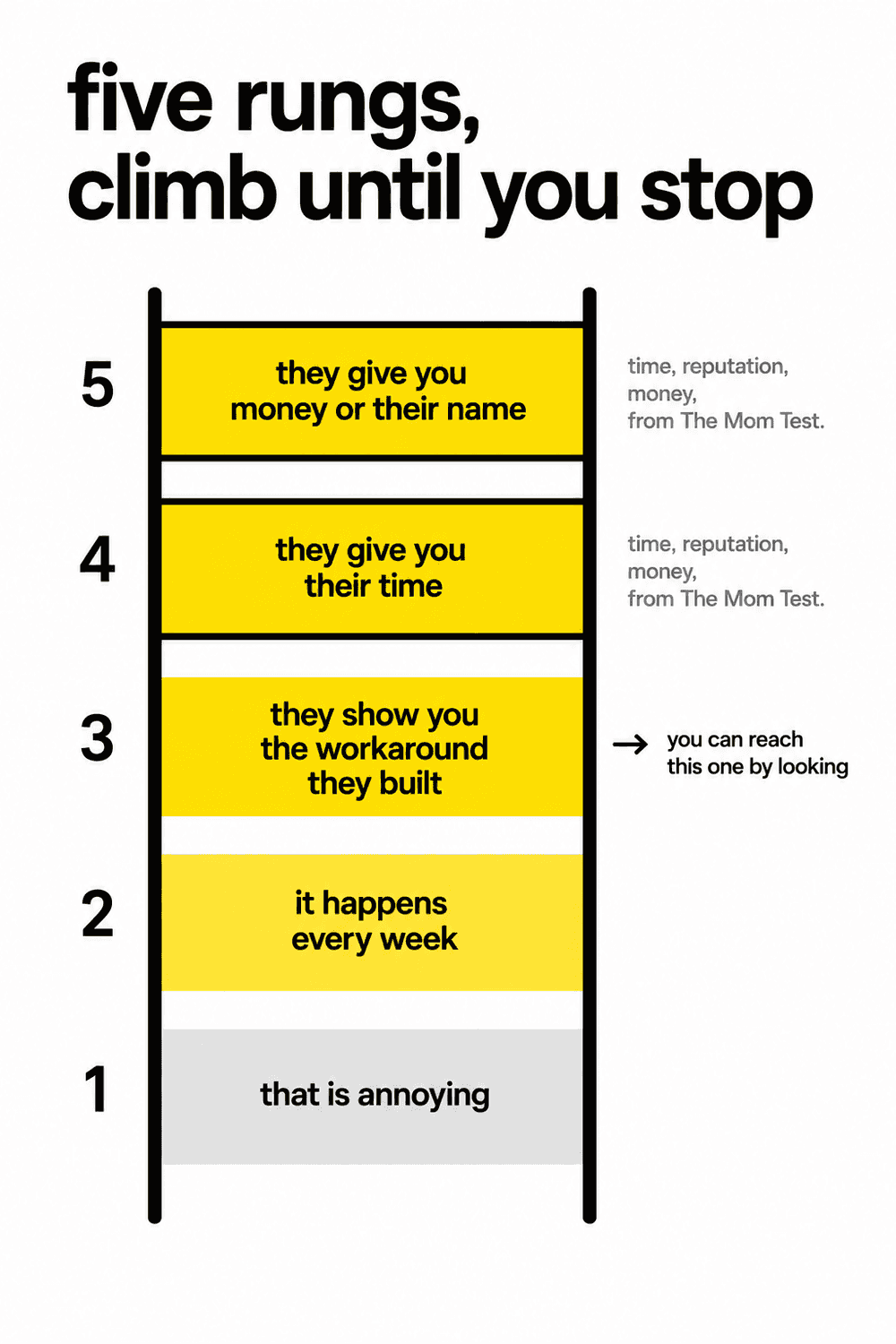
Think of it as five rungs on a ladder. Climb until you stop.
| Rung | What you hear or see | What it means |
|---|---|---|
| 1 | “That’s so annoying” | Nothing yet. Everybody says this |
| 2 | “That happens every week” | It repeats. Now write it down |
| 3 | They show you the clumsy object | They already paid time to survive it |
| 4 | They give you time, and let you watch again | Real |
| 5 | They give you money, or their name | Certain |
Rungs four and five are not mine. They come from Rob Fitzpatrick’s book The Mom Test, which says time, reputation and money are the three things that prove somebody means it. He is right and you should read it.
Rung three is the one that matters to you, because rungs four and five need access and confidence you may not have yet. You reach rung three just by looking. The tailor showed Diya the notebook without being asked.
Most teenage projects are built on rung one.
Then the weekly practice. Five steps, and the fifth is the one everybody skips.
Notice. Write it down. Check it repeats. Find the clumsy object. Go back.
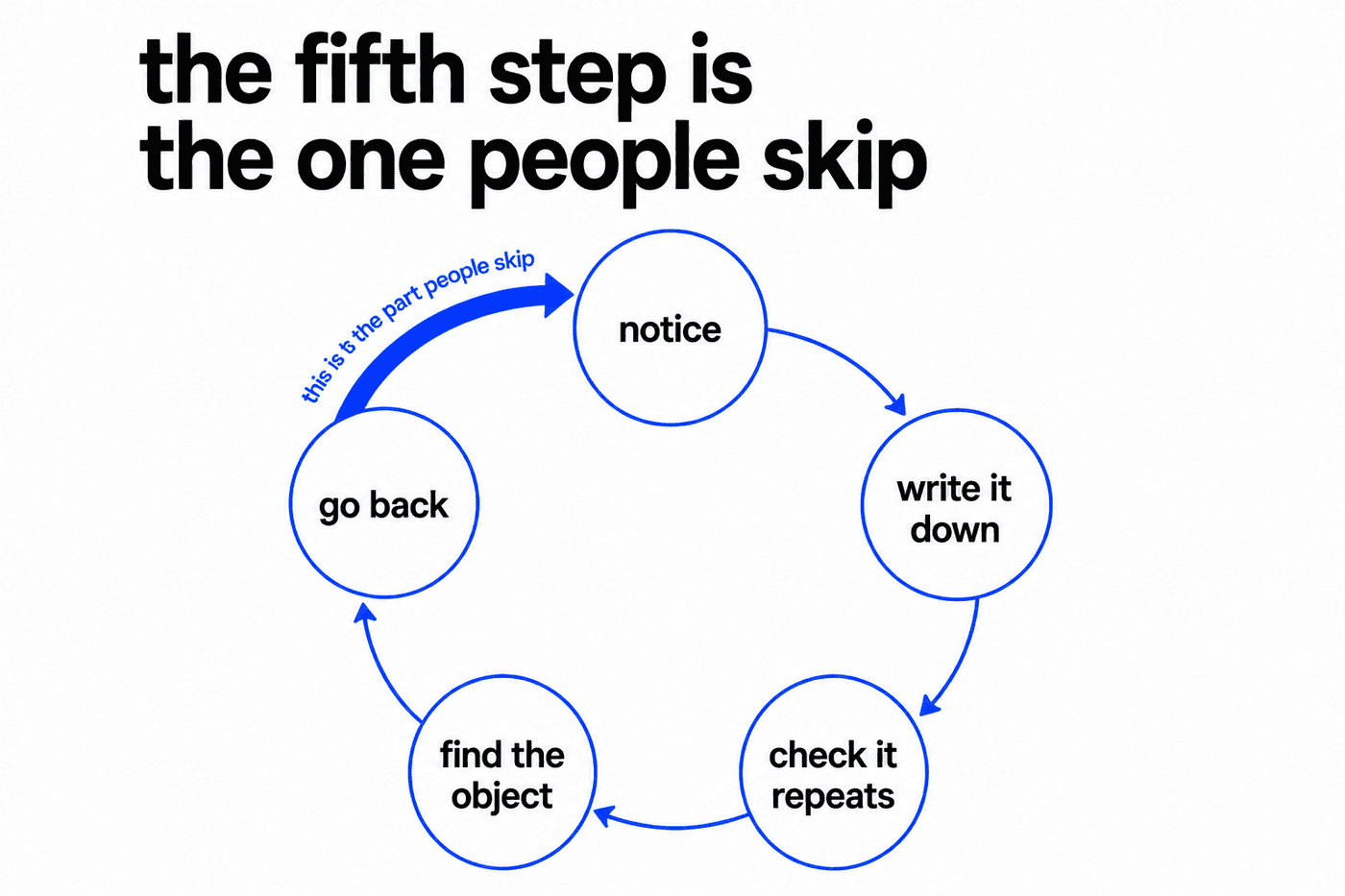
Go back is the whole thing. In our hundred cases, the problems that turned into real products came from people who could return to the same person again and again. Their family. Their school. Their own job. Meesho’s founder took that delivery job so he would keep hearing it.
Watching once gives you a wish. Watching twice gives you a problem.
Which is why the important part of Diya’s story is not the tailor’s notebook.
It is that she goes back the following Saturday.
Do this week
One thing, and only one.
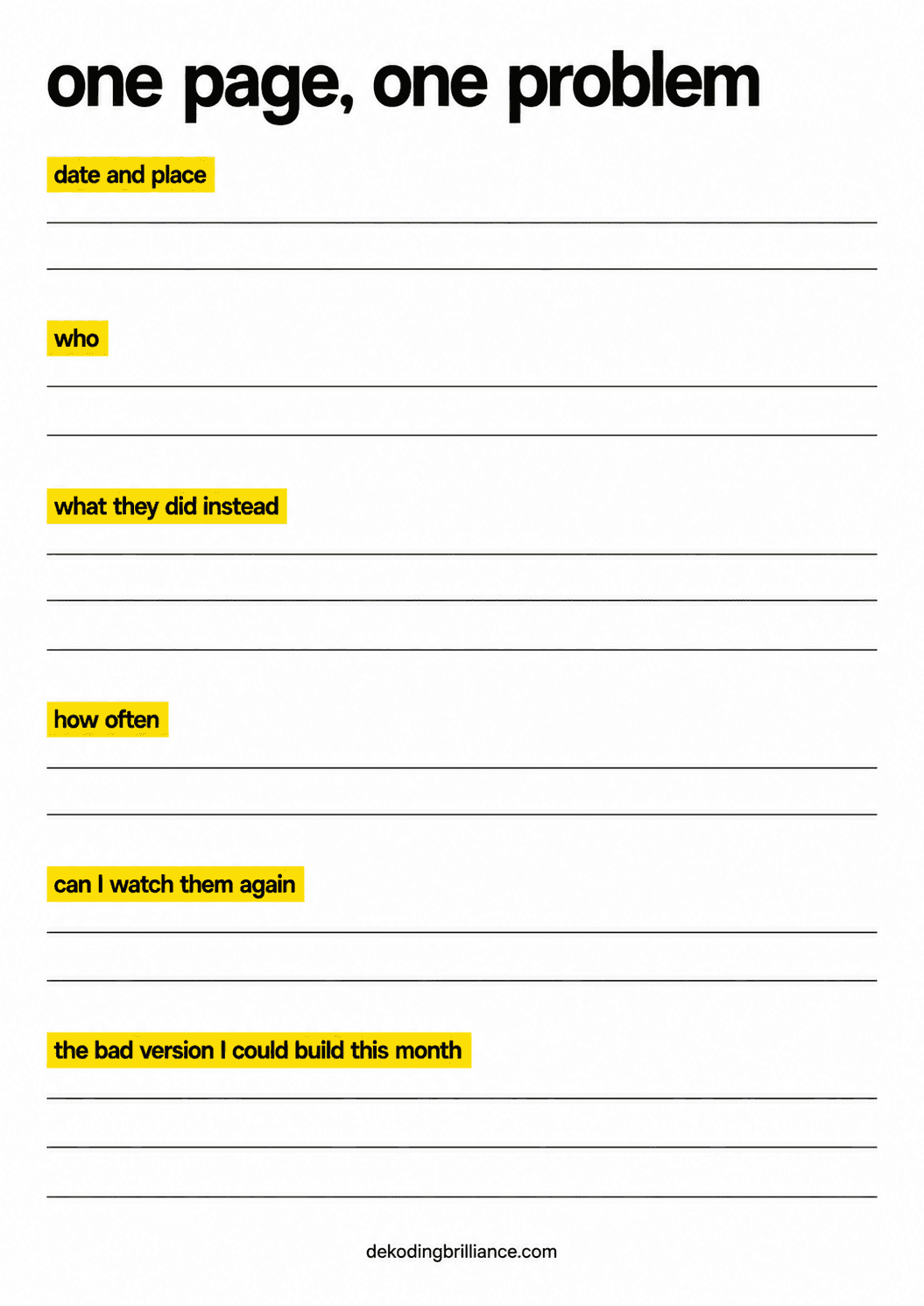
Print the notebook page below. Fill in one page. That means going to one place, watching one person, and writing down what they built to survive the problem.
One page. That is it. Then do it again next Saturday.
What next? Are you ready to dive in
Print one notebook page. Pick one place. Go on Saturday. The Builder’s Sprint is a six-week programme where twelve students take one problem they noticed and turn it into a real product.
Explore The Builder’s SprintCounts come from 100 verified origin statements collected in August 2026: 59 from Hacker News Show HN and IndieHackers, 29 from teenagers writing about their own projects and from Indian press interviews, and 12 Indian companies with a founder’s own words on record. Sources are linked inline.
FAQ
Where do most teenagers find their first real problem?
Is it better to solve my own problem or somebody else’s?
How do I know a problem is real and not just annoying?
Why does normal startup advice not work for teenagers?
How many people should I talk to?
Do I need a big idea?
What we could not check
Five things, said plainly, because the rest of this article is asking you to trust my counts.
- Diya is invented. She is a way of walking you through the research. Everything she notices is taken from a real case in the set. She has no company and no result, because I do not have one to give her honestly.
- The five things to watch for are a list, not a ranking. The words I used when searching pushed repetition to the top. When I searched again using different words, could not find came first. The two are very close, so do not read anything into the order.
- India’s two biggest school innovation schemes publish counts, not reasons. I found no student stated origins in either. Eight of my Indian teenage cases come from a single publication, and that is a real weakness in the set.
- Zerodha is not in here at all. I could not find a clean sentence from its founder saying what the original problem was, so I left it out.
- The insurance survey is an online panel that people choose to join, which is not the same thing as a national sample.
I threw out roughly 140 records that did not survive checking. One was a post claiming to be by a sixteen year old builder, which turned out to be copied word for word from another teenager’s post from 2014.

Nimish · Founder & CEO
20+ years in product and growth, including scaling redBus from 500,000 to 5 million users. MBA from Thunderbird, and founder of Dekoding Brilliance, which designs hands-on programs teaching high-schoolers operational, building, and research skills.