Everyone who answers this question is selling the answer
Do this before you read any further. Search “which career is safe from AI” and, instead of reading the results, read who owns them.
When I ran that search in the last week of August 2026, the first page was a freelancing marketplace, a company selling AI resume tools, an online high school selling diplomas, a job board selling interview coaching, and two universities answering “is a computer science degree still worth it” — while selling computer science degrees. Run it yourself; the specific names will have moved, the pattern will not.
I am not accusing any of them of lying. I am pointing at something simpler: not one of them can afford to give you an answer that reduces their enrolment.
Our position is not neutral either, and it is fairer to say so at the top than to bury it. Dekoding Brilliance runs paid programmes for students, and they are linked at the end of this guide. What we do not sell is a degree, a stream, a certificate or a career. Nothing in this article gets better or worse for us depending on which subject you choose, which is the specific conflict of interest that shapes almost every page you will find on this question.
So here is the honest version, with every number traced to where it came from.
Fair warning: the honest version does not end in a list of safe jobs. It ends in a test you can run yourself, on any career, for the rest of your life. I think that is a better trade. You can decide at the end.
Start with the number somebody has already quoted at you
If you have had this conversation at home in the last two months, there is a good chance one number came up: 37% of entry-level jobs in India are already being done by AI.
I went looking for that study.
It exists. Sort of.
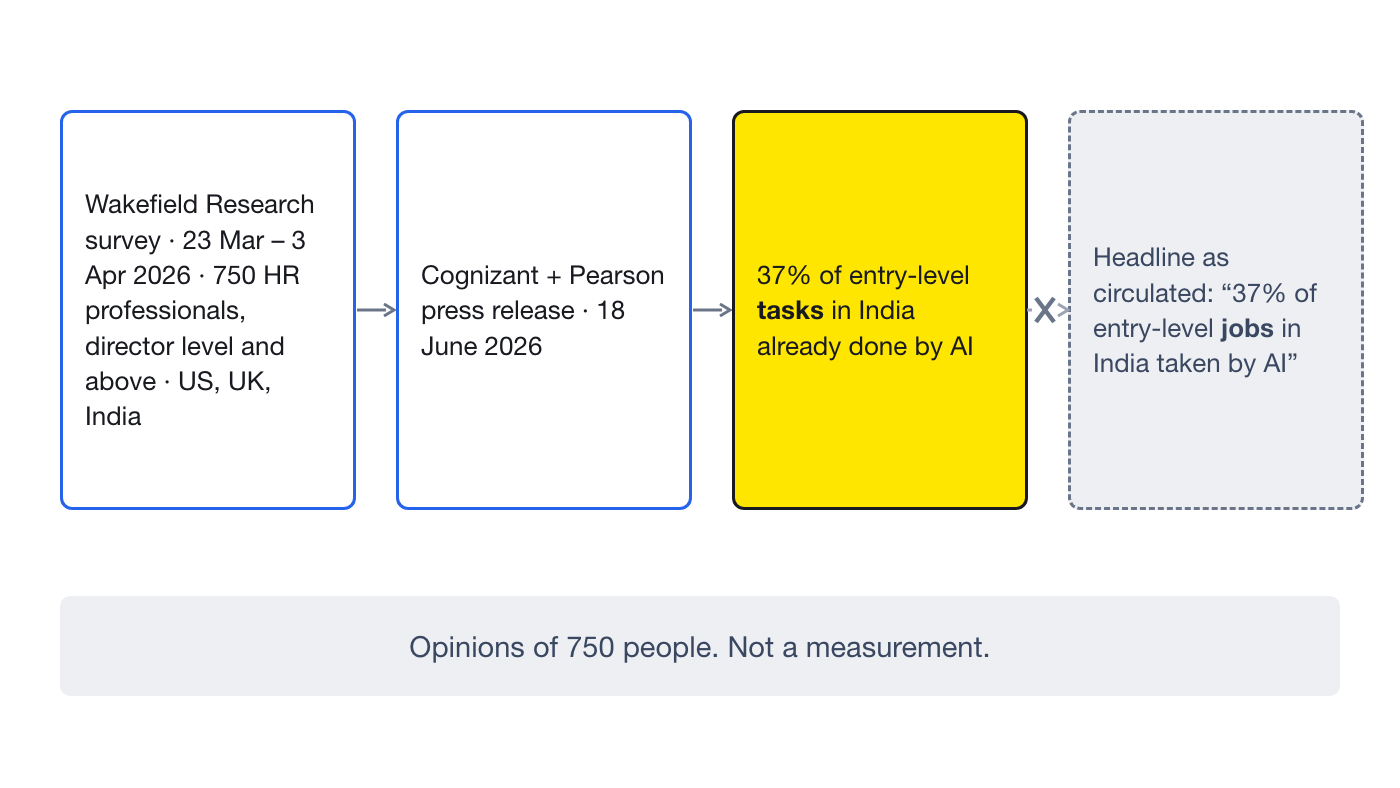
It comes from a press release published by Cognizant and Pearson on 18 June 2026. The research behind it was carried out by Wakefield Research between 23 March and 3 April 2026. The sample was 750 HR professionals at director level and above, at companies with more than 1,000 employees, across the US, the UK and India.
Three things about it.
One. The original headline says tasks, not jobs. “37% of entry-level tasks in India already done by AI.” Somewhere between the press release and the WhatsApp forward, “tasks” became “jobs.” Those are not the same claim. Answering an email is a task. Being hired is a job.
Two. It is not a measurement. Nobody counted jobs. Somebody emailed 750 senior HR managers and asked them to estimate. It is a record of what a few hundred people believe.
Three. It was commissioned by two companies that sell AI-era skilling and workforce services. That does not make it false. It does mean you should want a second source, and there isn’t one.
I am starting here because the check takes ninety seconds and it is the most useful habit in this whole subject: before you rearrange your child’s future around a statistic, find out who counted, what they counted, and who paid for the counting.
Almost every number in this argument fails that test. A few survive. Those are the ones worth your time.
The study everyone cites says the opposite of what you were told
The most serious piece of evidence in this entire debate is a paper called Canaries in the Coal Mine? Six Facts about the Recent Employment Effects of Artificial Intelligence, by Erik Brynjolfsson, Bharat Chandar and Ruyu Chen at Stanford’s Digital Economy Lab. The latest version came out on 12 August 2026, using ADP payroll records through June 2026 — actual pay data for millions of American workers, not a survey.
It is the paper behind most of the scary headlines you have seen this month.
Here is its own first finding, in its own words:
“We find no evidence of widespread, economy-wide job displacement from AI.”
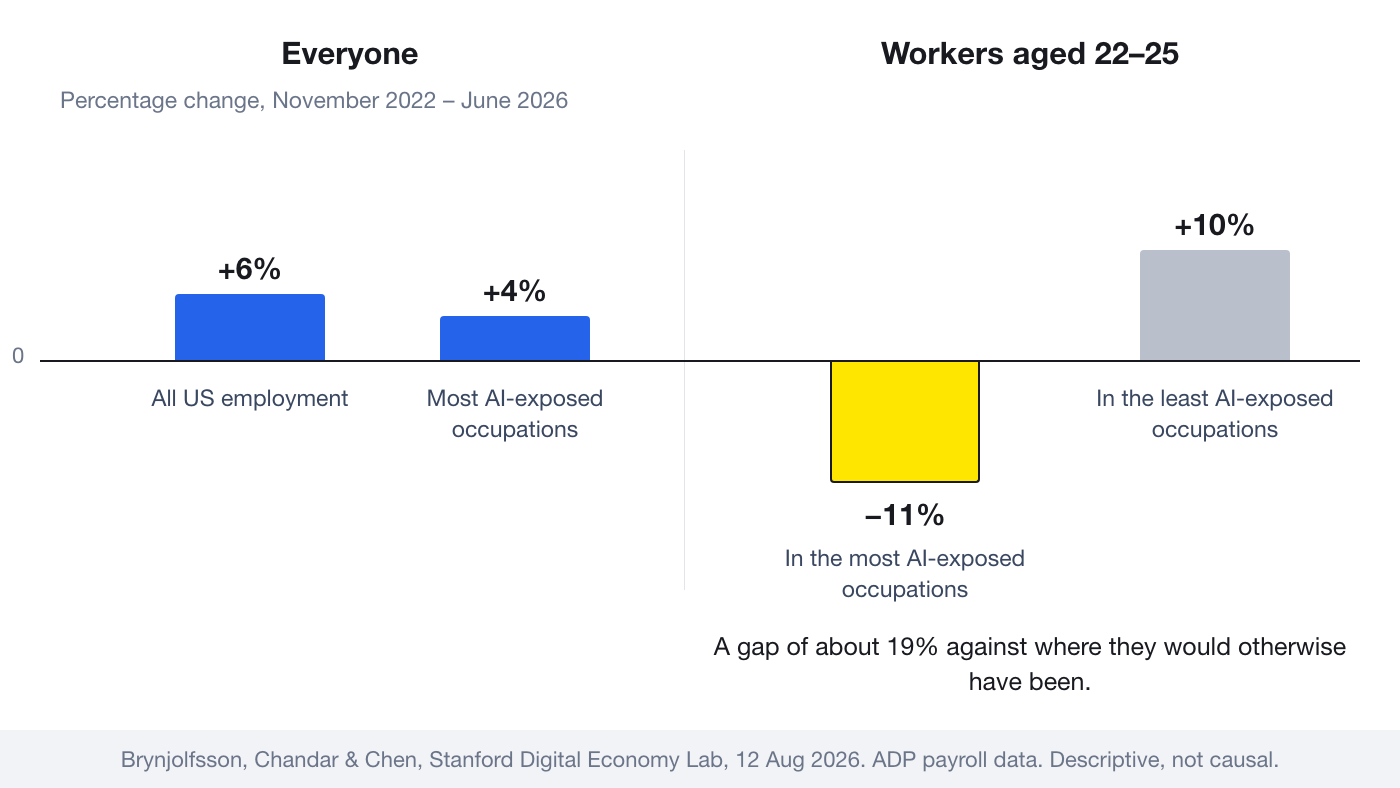
Across the period they study, American employment grew about 6%. Even in the fifth of occupations most exposed to AI, employment still grew about 4%.
That is the headline of the study that is being used to tell you the sky is falling.
So what did they actually find? Something narrower, and genuinely worrying.
For workers aged 22 to 25 in AI-exposed occupations, employment now sits 19% below where it would have been if it had kept pace with their less-exposed peers. In absolute terms, between November 2022 and June 2026, employment for 22–25 year olds in the two most exposed occupation groups fell about 11%, while the same age group in the three least exposed groups grew about 10%.
Three details matter more than the 19%.
The gap is widening. It was 15% in the July 2025 data. It is 19% now.
Nobody is being fired. The authors are explicit that the effect “operates primarily through reduced hiring of young workers rather than increased separations.” Separation rates actually fell. The door is not slamming. It is opening less often.
It only shows up where AI substitutes. Where AI is used to automate a person’s tasks, young employment falls. Where AI is used to complement a person, the authors report employment is “flat or rising, especially for experienced workers.” The same statistical measure that produces a negative number for 22–25 year olds produces a positive one for 41–49 year olds.
Now the part the headlines skipped, which the authors put in their own paper:
- “We caution that this work does not estimate a causal impact of AI: these are descriptive facts.”
- The effect roughly halves once they control for how educated an occupation is. They say plainly that this “raises questions about whether education disruption or AI exposure drives patterns.”
- Their payroll dataset shows a clear gap. The US Census Bureau’s own household survey, over a comparable window, shows a gap so small it is statistically indistinguishable from zero.
- Some of the divergence between exposed and unexposed occupations started before ChatGPT existed.
This is a good study, run by serious people, who are being honest about what it can and cannot prove. It deserves to be read that way rather than shouted.
Three other datasets say three other things
If the Stanford finding were the whole picture, everything else would point the same way. It doesn’t.
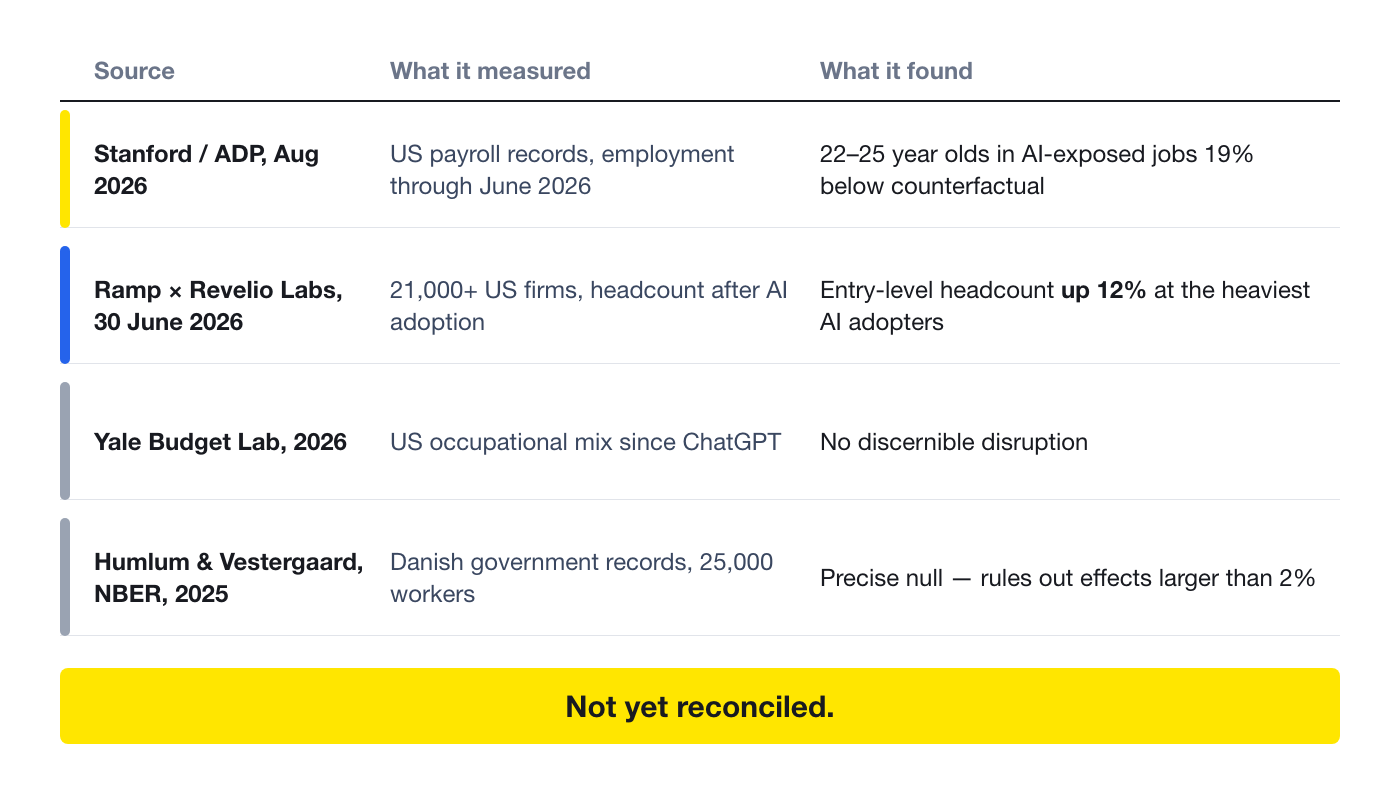
A firm-level dataset points the opposite way. Ramp and Revelio Labs looked at more than 21,000 American companies and published on 30 June 2026. The firms spending the most on AI grew headcount 10.2% in the two years after adoption — and their entry-level headcount rose 12%. Anders Humlum of the University of Chicago put it bluntly: “the firms that are paying a lot of money to Anthropic and OpenAI to subscribe to their models, they are hiring more than anyone else.”
A national dataset shows nothing at all. Yale’s Budget Lab, tracking how America’s occupational mix has shifted since ChatGPT launched: “The broader labor market has not experienced a discernible disruption.”
A study with clean government records found a precise zero. Anders Humlum and Emilie Vestergaard used Danish administrative data — 25,000 workers across 7,000 workplaces in the most exposed occupations — and reported “precise null effects on earnings and recorded hours,” ruling out any effect larger than 2% two years after ChatGPT’s launch.
And the timing is contested by people who study this for a living. David Deming at Harvard, speaking to NPR on 18 August 2026: “If you look very carefully at the timing, it looks like the decline in junior hiring actually started a bit like six months before ChatGPT was released.” His candidate explanation is remote work, not AI — it is expensive to train a junior over video, so firms hire seniors instead.
I want to be careful here, because it would be easy to use this section to say “so it’s all nonsense.” That is not what it says either.
What it says is: one high-quality dataset shows real harm at the entry level, one shows the opposite, one shows nothing, and the authors of the first one are the ones telling you not to over-read it. Anyone presenting this as settled — in either direction — is telling you about their confidence, not about the evidence.
It has not shown up in India’s aggregate numbers
Every number above is American or Danish. India is not in any of them.
So I went looking for the Indian version.
There isn’t one. Nobody has measured AI’s effect on Indian entry-level employment using payroll or employment records. The closest thing available is Naukri’s JobSpeak index, which tracks job postings on India’s largest job board. That distinction matters and I am going to keep repeating it: a posting is an employer advertising demand. It is not a person hired. Here is June 2026, year on year:
| Change | |
|---|---|
| White-collar hiring overall | +6% |
| Freshers (0–3 years) | +8% |
| 4–7 years experience | +2% |
| AI/ML roles | +25% |
| IT sector | −3% |
| Banking | −12% |
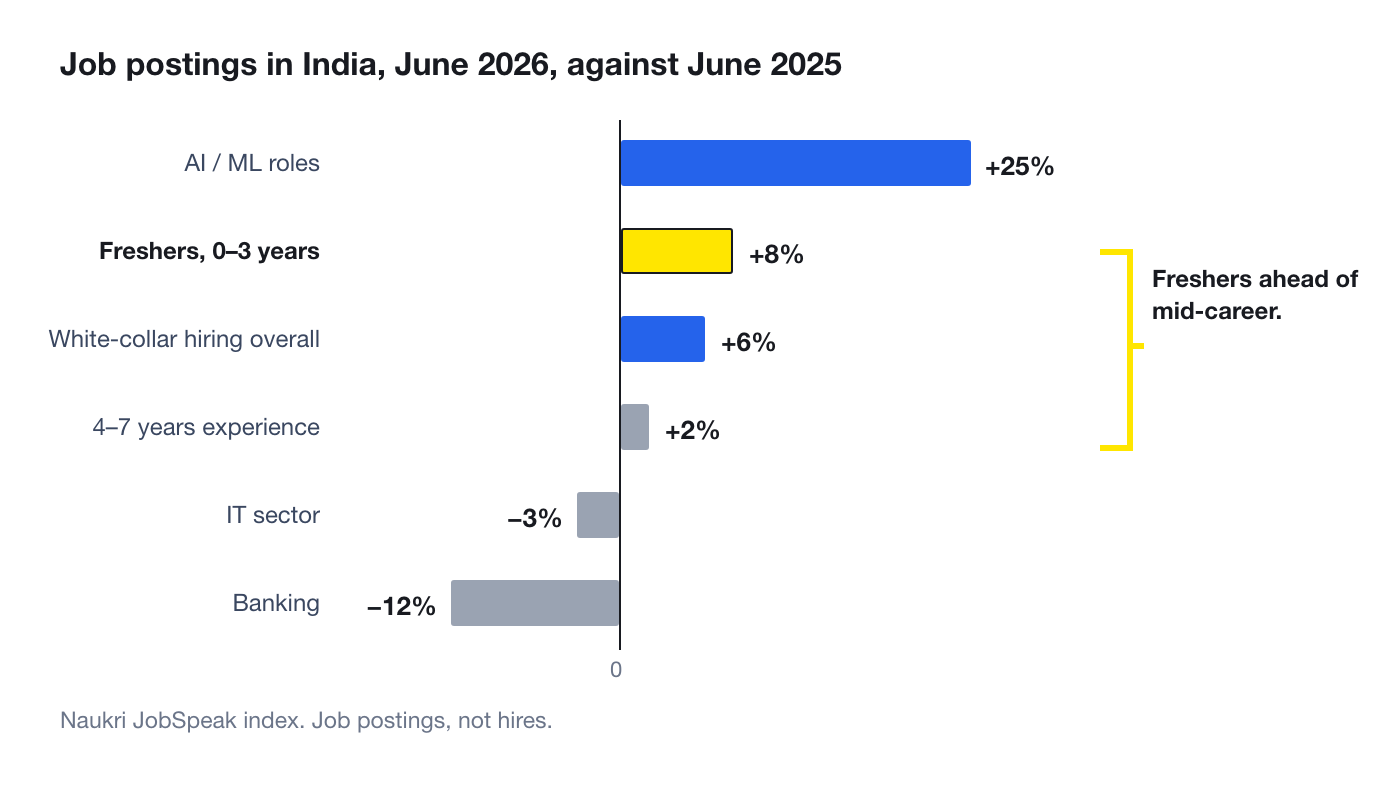
Read the first three rows again.
If AI were removing the bottom rung of the Indian ladder the way it appears to be doing in American payroll data, fresher postings would be the worst-performing band. They are the strongest-growing band. Employers are advertising for freshers faster than for people with four to seven years of experience.
The official numbers point the same way. India’s Periodic Labour Force Survey for 2025, released on 27 March 2026, reports youth unemployment (ages 15–29) falling to 9.9% from 10.3%, and unemployment among people with secondary education and above falling to 6.5% from 7.0%.
Two honest limits on all of that. Postings measure what employers are asking for, not what they end up doing — a market can advertise enthusiastically and convert badly. And the PLFS youth figure covers everyone aged 15 to 29, most of whom are not graduates; we will come back to what happens to the graduates specifically, because it is a much less comfortable number.
Meanwhile, the two loudest Indian stories point in opposite directions, and both are widely misreported.
TCS cut around 12,000 roles in July 2025 — about 2% of its workforce, the largest reduction in its history. It got reported everywhere as an AI story. The company’s own CEO, K. Krithivasan, said this: “This is not because of AI giving some 20 percent productivity gains.” He attributed it to skill mismatch and to people the company had not been able to deploy. The cuts fell mainly on mid and senior staff on the bench — the opposite shape from the American entry-level story.
Cognizant hired 20,000 entry-level graduates in 2025 and has said it will hire more in 2026. Its CEO, Ravi Kumar S, told Fortune on 1 June 2026: “There was a little bit of fearmongering from reading about the fact that there’s going to be a collapse of jobs. I think there will be more jobs.”
The honest summary for an Indian family, as of today: the entry-level squeeze is real in American payroll data, contested by other American data, and not visible in India’s aggregate numbers.
Aggregate is doing work in that sentence, and I do not want to hide behind it. Something is happening in one part of the market. IT postings are down 3%. The top five Indian IT firms shrank by about 7,000 people in FY26 after adding nearly 13,000 the year before. And the specific work that used to make up a fresher’s first eighteen months in a services company — manual testing, first-line support, routine maintenance coding — is genuinely thinning out. We come back to this in the section on software. The field is not shrinking. The old on-ramp into it is.
Nor is this a promise that the wider effect will never arrive. India’s own NITI Aayog, in a roadmap published with NASSCOM and BCG in October 2025, projected that up to 2 million jobs in India’s tech and customer-experience sector could be displaced over five years, alongside up to 4 million new roles created. That is a scenario, not a measurement — no methodology was published with it, and you should hold it loosely. But note which jobs it named as most at risk: QA engineers and L1 support agents.
The 2016 prediction that should make everyone humble
In 2016, Geoffrey Hinton — one of the people who built modern AI, and later a Nobel laureate — stood in front of a room in Toronto and said:
“People should stop training radiologists now.”
He gave the profession about five years. He compared radiologists to a cartoon coyote who has run off a cliff and hasn’t looked down yet.
He was not being reckless. He was right about the technology. There are now more than 700 FDA-cleared radiology AI models — roughly three-quarters of every AI medical device ever cleared in the United States. Machines really did learn to read scans.
Ten years on, here is what happened to radiologists, from reporting by Deena Mousa published in October 2025:
- 1,208 diagnostic radiology residency positions were offered in the US in 2025 — a 4% increase on 2024.
- Radiology is now one of the most competitive and best-paid specialties in American medicine.
- Average radiologist income in the US was around $520,000 in 2025 — 48% higher than in 2015.
- Vacancy rates are at record highs. There are not enough of them.
Why?
Because of one number from a 2012 study: radiologists spend about 36% of their time actually interpreting images. The rest is talking to other doctors, explaining findings to patients, designing protocols, performing procedures, teaching, and — critically — carrying the legal responsibility for being wrong.
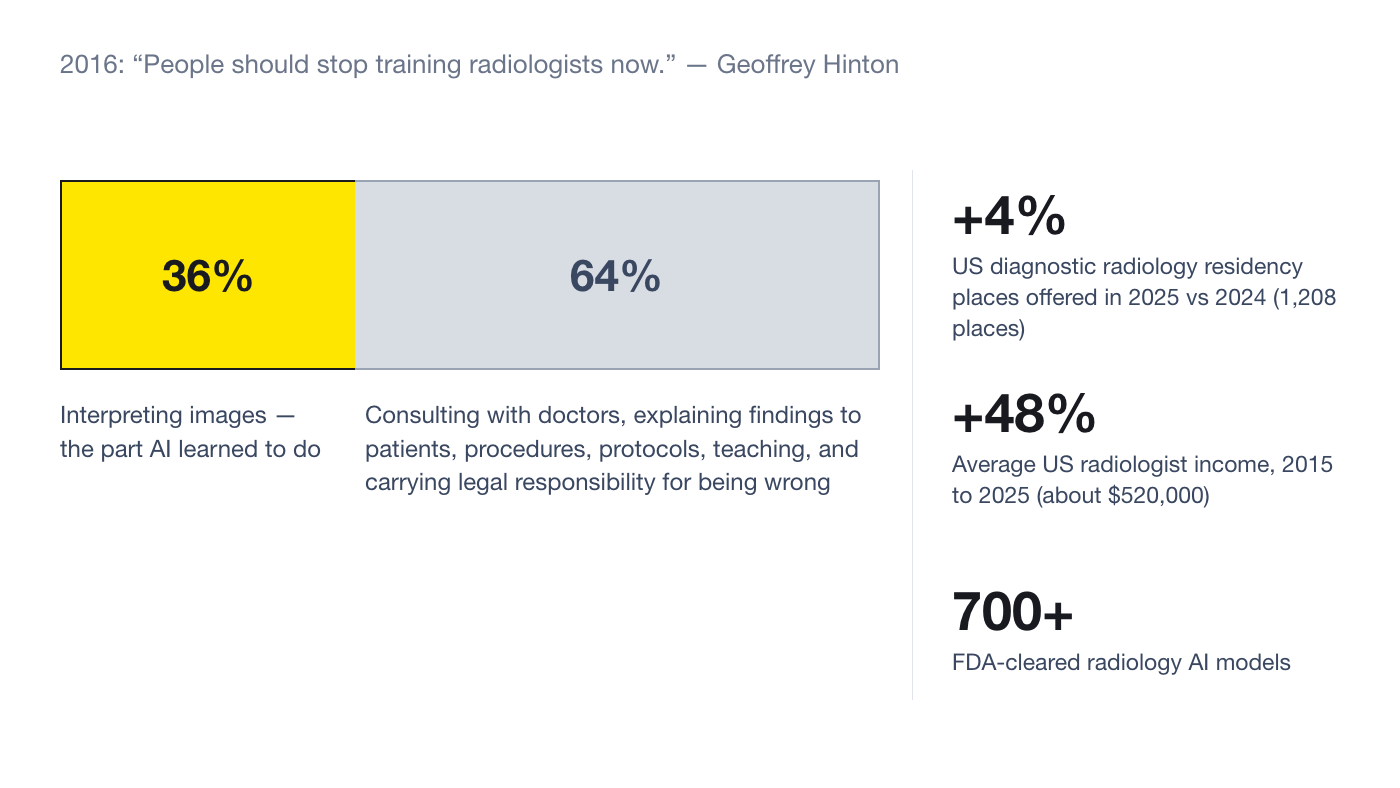
Hinton correctly predicted that AI would read scans. He incorrectly assumed that reading scans was the job.
For India this matters even more. India has roughly one radiologist per 100,000 people. In a country that short of them, better software does not shrink the profession. It is the only realistic way of reaching the people currently getting no scan read at all.
And the last big “which jobs are safe” prediction was wrong in a specific, checkable way
In 2013, Carl Benedikt Frey and Michael Osborne at Oxford published the study that started all of this. You know the number: 47% of US jobs at risk of computerisation.
Read what they actually wrote:
“According to our estimate, 47 percent of total US employment is in the high risk category, meaning that associated occupations are potentially automatable over some unspecified number of years, perhaps a decade or two.”
Potentially automatable. Over some unspecified number of years. They also said explicitly that they limited themselves “to the substitution effect” and made “no attempt to forecast future changes in the occupational composition.” They modelled destruction and told you they weren’t modelling creation.
The popular version of that statistic — “AI will take 47% of jobs” — is not a finding. It is a distortion of a paper that said something much more careful.
So how did the risk ranking hold up? Robert Atkinson at ITIF checked in 2022. The occupation Frey and Osborne ranked among the highest risk — insurance underwriters — had grown 16.4%. One of the occupations ranked safest — recreational therapists — had declined 8.9%.
The most careful check is an OECD working paper by Alexandre Georgieff and Anna Milanez (January 2021), covering 21 countries from 2012 to 2019. Their finding is the most useful sentence in this entire subject:
“employment growth has been much lower in jobs at high risk of automation (6%) than in jobs at low risk (18%).”
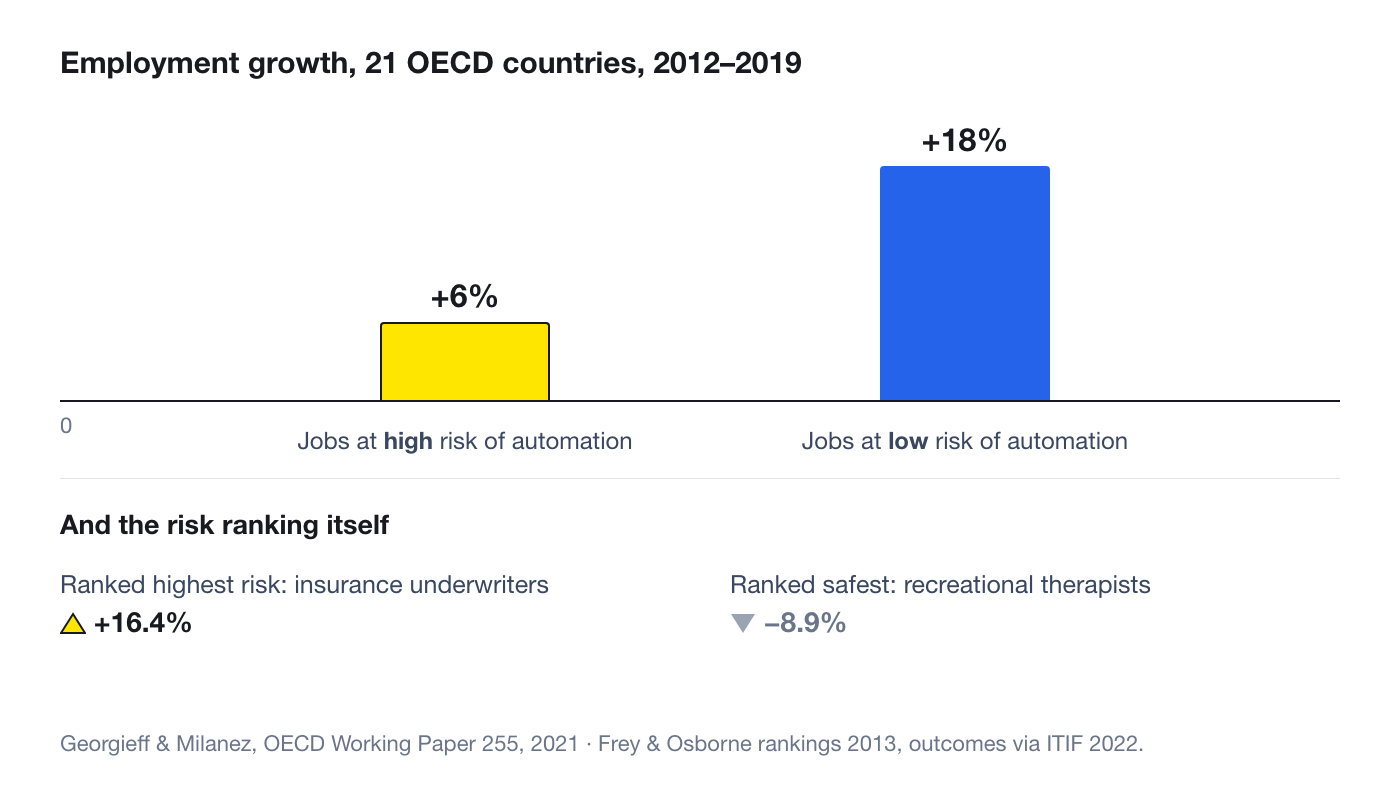
Six percent. Not minus sixty. The jobs everyone said would disappear grew — just three times more slowly than everything else.
That is what automation risk usually looks like in real life. Not a cliff. A slower escalator.
And one more, because it is the story people tell only half of. When ATMs arrived, the number of bank tellers famously did not fall — cheaper branches meant more branches, and the job shifted from counting cash to talking to customers. That part is true.
Here is the ending nobody quotes. US teller employment plateaued at roughly 545,000 in the late 2000s. By May 2023 the Bureau of Labor Statistics counted 340,820. That is a fall of about 37%, already observed — no forecast required. The cause was not the ATM. It was online and mobile banking, arriving about thirty years after everyone had finished worrying about the machine in the wall.
Two lessons sit in that, and the second is the useful one. The first is that the job did eventually shrink. The second is that the technology which shrank it was not the technology anybody was watching at the time — which is a reason to be humble about anything anyone tells you today, this article included.
So here is the rule that actually holds
Put all of it together and one line survives every dataset in this piece:
Exposure attaches to tasks, not to job titles.
The Stanford authors describe the underlying distinction as codified versus tacit knowledge. Codified knowledge is written down, standardised, documented — the stuff you can learn from a manual. Tacit knowledge is what you get from practice, mentorship and repetition: judgement, context, knowing which rule doesn’t apply here.
AI is very good at codified. It is poor at tacit, and it cannot hold responsibility at all.
Which gives you a test. Three questions, about any career, forever.
1. Is the task the whole job?
Look at what NITI Aayog named as most at risk in India: QA engineers and L1 support agents. What do those two roles have in common? The task is the job. A first-line support agent’s entire role is answering a defined set of questions from a defined script. There is nothing left over when you automate the script.
Radiology is the opposite. Automate image interpretation and you have removed 36% of the day. The other 64% — and all of the liability — is still sitting there.
2. Does somebody have to be legally responsible?
This is the strongest and least discussed moat in the whole subject. A chartered accountant’s signature on an audit is not a description of work performed. It is an assumption of legal liability. No software can sign it, because no software can be sued.
3. Is the knowledge codified or tacit?
Anything that can be fully written into a procedure is exposed. Anything that requires reading a room, weighing incomplete evidence, or knowing when the procedure is wrong is not — at least not yet.
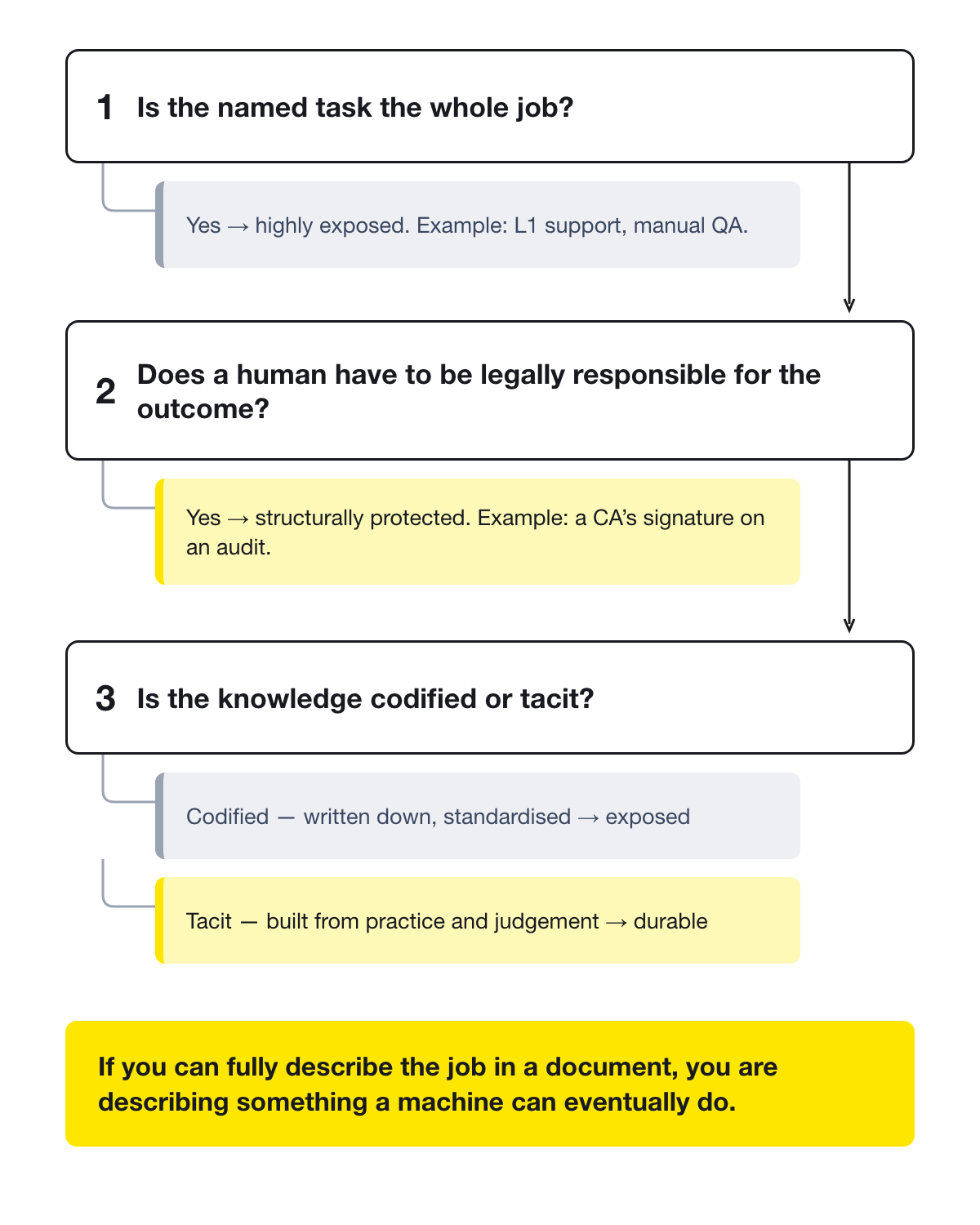
A useful way to hold all three: if you can fully describe your job in a document, you are describing something a machine can eventually do. If your job is mostly the part you couldn’t write down, you are safer than the headlines suggest.
Run the test on the five careers Indian families actually argue about
Not a safe list. Just the test, applied honestly.
Software engineering. The most exposed rung, not the most exposed field. India’s IT job postings were down 3% year on year in June 2026 while AI/ML postings were up 25%. But every one of the big five Indian services firms is still recruiting freshers — TCS has said 25,000 for FY27. What is eroding is the classic first rung of the services pyramid: manual QA, L1 support and routine maintenance coding. Run question 1 on those three and you can see why. The task is the job. A student who arrives with things they have actually built is applying for a different rung altogether.
Chartered accountancy. Question 2 protects it structurally. The ICAI’s response has been adoption, not defence — its then-president said in February 2025 that 12,000 CAs had completed a one-year AI certificate programme with training for over 15,000 more in the pipeline. Note what is exposed inside CA work, though: reconciliation, data entry, first-pass ledger checks. The ILO’s own occupational exposure index puts clerical work at the top of the exposure list globally, and accounting clerks by name. The qualification is protected. The apprenticeship years are not.
Medicine. See radiology. The prediction was famous, specific and wrong, and it was wrong in a way that teaches you the rule.
Law. The sharpest example of the training-pipeline problem. AZB & Partners deployed the legal AI tool Harvey firm-wide in September 2025; Indian courts have over 50 million pending cases and ₹53.57 crore allocated for AI tools under eCourts Phase III. Drafting and document review — the work through which junior advocates historically learned — is exactly what gets automated first. And at the same time, by early 2026 the Supreme Court had to deal with more than 100 fabricated case citations in a single commercial appeal, and in July 2025 the Kerala High Court became the first in India to bar AI use in district court findings. Both things are true at once: the grunt work is disappearing, and the value of a human who can verify has gone up.
Design and content. The one category where the measured effect is genuinely negative. Research using Upwork data found that after ChatGPT launched, writing freelancers saw roughly a 2% fall in new monthly contracts and a 5% fall in earnings, with graphic designers showing near-identical effects after image models arrived. The uncomfortable detail: high-skill freelancers were hit harder than low-skill ones. AI compressed the premium for being good. I could find no equivalent Indian dataset, and I looked.
The uncomfortable part: “just learn AI” is not the answer either
This is the advice everybody is giving, including people I respect. I want to be honest about what the evidence says about it, because the evidence is not flattering.
AI helps beginners far more than it helps experts. In a study of 5,179 customer support agents published in the Quarterly Journal of Economics in April 2025, access to an AI assistant raised productivity by 14% on average — but 34% for novices and low-skilled workers, with minimal impact on the experienced and highly skilled.
Read that as a career strategy and it stings. If the tool lifts the bottom and barely moves the top, then “be the person who uses AI” describes an advantage the tool is actively erasing. It is a leveller, not a ladder.
People are bad at knowing whether it is helping them. In a randomised trial published by METR in July 2025, 16 experienced open-source developers worked through 246 real issues on their own large repositories. With AI tools allowed, they were 19% slower. Afterwards, they estimated AI had made them 20% faster. Sixteen developers is a small study and you should weigh it accordingly — but it is a randomised one, on real work, and the direction of the error is the point.
And the flagship “new AI job” has already dissolved. Prompt engineering was the job title of 2023. By 2025 it had been absorbed into other roles. Allison Shrivastava at Indeed’s Hiring Lab described it being folded into machine learning engineering and automation architect titles. The skill did not stop mattering. It stopped being a job.
There is one large study pointing the other way, and it deserves an honest reading. PwC’s 2026 AI Jobs Barometer, built on around a billion job advertisements, found AI-skilled workers commanding a 62% wage premium, up from 57% the year before. But that is a premium on job ads, not a measurement of what happens to a person who learns a tool. And a premium is by definition a scarcity rent. If everybody follows the advice, the premium disappears. That is not a reason to ignore AI. It is a reason not to mistake it for a moat.
The genuinely useful finding buried in that same PwC report is this: entry-level roles most exposed to AI are now seven times more likely to require what PwC calls human-intensive skills — leadership, creativity, face-to-face judgement. And those “seniorised” entry-level roles grew 35% since 2019, while other entry-level roles declined 10%.
So the instruction is not “learn AI.” AI fluency is table stakes; it will be as differentiating as knowing how to use email.
The instruction is: become someone who can be trusted with responsibility early, and have evidence of it.
The Indian number that matters more than any of this
Here is where I think the whole conversation has been going wrong in Indian homes.
India’s Economic Survey 2024-25, drawing on the Periodic Labour Force Survey, reports that over 53% of Indian graduates are working in jobs below their educational qualification — in elementary or semi-skilled occupations. For postgraduates the figure is around 36%.
Azim Premji University’s State of Working India 2026, released in March 2026, found that around 40% of graduates under the age of 25 are unemployed — and, crucially, that graduate unemployment has sat in the 35–40% band since 1983. Before the internet. Before smartphones. Before AI existed as anything but a research topic.
That 40% will look like it contradicts the 9.9% youth unemployment figure from earlier. It does not. The 9.9% covers everyone aged 15 to 29, most of whom never went to college and take whatever work is available. Graduate unemployment in India runs far higher and always has, partly because a graduate can usually afford to wait for work that matches the degree — and, as the Economic Survey number shows, often ends up not getting it anyway.
And the OECD, looking at teenagers across dozens of countries, reports that job expectations at 15 “have changed little since 2000 and bear little relationship to actual patterns of labour market demand.”
Put those together and you get something more useful than any forecast:
Choosing a career at 16 and having it hold has never worked in India. AI did not break that. AI just removed the last excuse for pretending otherwise.
Which is why “which career is safe from AI” is the wrong question — not because it is a silly question, but because it assumes a mechanism that has not applied in this country for forty years. You were never going to be protected by the label on the degree. You are going to be protected, to whatever extent anyone is, by what you can demonstrably do and by whether anyone will trust you with responsibility.
What this means for the stream after Class 10, and for the money
Two decisions are actually on the table in most Indian homes right now. One belongs to the student and gets made at fifteen. The other belongs to the parent and involves several lakh rupees. The test above answers both, but only if you apply it to the right thing.
The stream decision. There is no AI-proof stream. Science does not protect you, and Commerce and Arts are not more exposed — the ILO’s global exposure index puts clerical and back-office work at the top of the exposed list, and that work sits under every stream. What the stream actually decides is which doors stay open for the next four years. So choose it the way you would choose any option with a long expiry: keep the widest set of doors you can genuinely walk through, and do not take Science purely as insurance if the marks are going to be a struggle, because a poor score in a “safe” stream closes more doors than a strong one in an “unsafe” stream.
Then ignore the stream for a moment and ask the useful question instead: what will you spend the next four years accumulating that is not a mark sheet? That question has the same answer in every stream.
The degree decision, and the money. This is the one nobody writes for parents, so let me be direct about it.
The evidence in this article does not say “don’t fund the degree.” Azim Premji University’s State of Working India 2026 — the same report that carries the 40% figure above — finds that graduates in India still out-earn non-graduates both at entry and across a working life. What the evidence says is narrower and more awkward: the degree is necessary and it is not sufficient, and the gap between those two words is where families lose money. Over half of Indian graduates end up in work below the level of their qualification. The first rung of the services pyramid — the rung a fresh graduate has historically stepped onto — is the exact rung that is thinning. Paying for the credential and expecting the credential to do the placing is the strategy that has been failing quietly since well before AI arrived.
So three things worth weighing before the money goes out.
One. Ask what the course does about the on-ramp, not what it teaches. Placement rate is the number colleges advertise; the number that matters is what the students actually did — internships, real projects, work shown to real users. A programme that produces graduates with nothing to show has passed the cost of the missing rung on to you.
Two. Price the evidence, not just the fees. If two options cost roughly the same and one of them gets your child in front of real work two years earlier, that is not a soft benefit. On this article’s own logic — that responsibility is the thing that cannot be automated and cannot be bought — it is the main thing you are paying for.
Three. Do not buy insurance you cannot verify. “AI-proof”, “future-ready” and “industry 4.0” are marketing words with no test behind them. If a programme claims a career is protected, ask the three questions of that career yourself. It takes a minute, and it is the same minute you would spend checking any other large purchase.
So what do you actually do
Five things. In order of how much they matter, not how easy they are.
1. Stop optimising for the label. Start optimising for the evidence.
Nobody can check whether you are “good at AI.” Anybody can check a thing you made. One finished project that a real person used beats three certificates, and it is the only asset in this list that AI does not commoditise.
2. Choose the field for the tacit part, not the codified part.
When you are weighing medicine against engineering against CA against design, do not ask which is safest. Ask: in this job, what is the part that could not be written down in a manual? If the honest answer is “not much,” think harder. If it is “most of it,” you are in reasonable shape whatever happens to the tools.
3. Get near the responsibility earlier than is comfortable.
The thing that protected radiologists was carrying the consequences of being wrong. You cannot buy that. You can only accumulate it, and you accumulate it by doing things where the outcome is actually yours — running the event, handling the money, shipping the thing, facing the customer who is unhappy.
4. Learn AI the way you learned typing — and then measure whether it is helping.
Use it daily, assume no advantage from it, and remember the METR result: people were 19% slower while feeling 20% faster. Time yourself on a real task with and without it, once. Most people never do, and that is why most people are wrong about it.
5. Keep a record.
Not a résumé. A record: what you built, when, who used it, what broke, what you changed. In a market where more than half of graduates end up working below the level of their degree, the person with a documented trail of solved problems is a fundamentally different candidate from the person holding only a transcript.
An honest note about who this advice is actually available to
I would be writing badly if I skipped this.
Connectivity in India is largely solved. The NSS telecom survey for January–March 2025 found 86.3% of households have internet access at home — 83.3% rural — and over 90% of 15–29 year olds had used the internet in the previous three months.
Devices are not solved. The Comprehensive Annual Modular Survey found that fewer than 10% of Indian households own a computer or laptop — about 4% in rural India. ASER 2024 found that while roughly 90% of 14–16 year olds have a smartphone in the house, only 27% of 14 year olds and 37.8% of 16 year olds own one themselves. And ASER 2023 found personal ownership running at 43.7% for boys against 19.8% for girls.
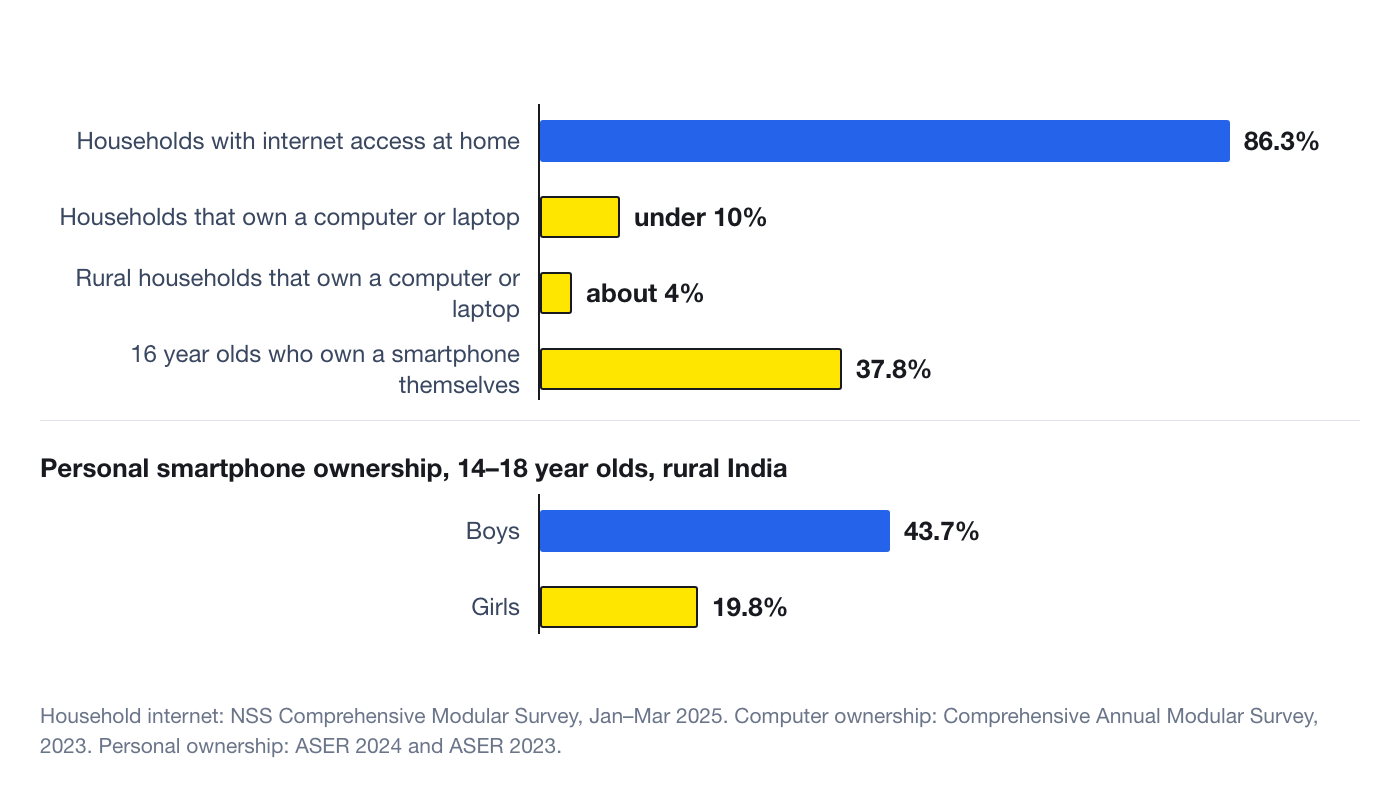
So if the advice is “build things and show the evidence,” it is worth saying plainly: for a large share of Indian teenagers that means a shared phone, in the evening, on someone else’s schedule. Every one of the five points above still works from a phone — a documented record, a real problem solved for a real person, responsibility taken. None of them requires a laptop. But the version where you build software does, and pretending otherwise would be writing for the top decile while addressing the country.
Do this one thing this week
Take the career your family is currently arguing about. Just one.
Find somebody actually doing it — a cousin, a neighbour, a parent’s colleague, anyone — and ask them one question:
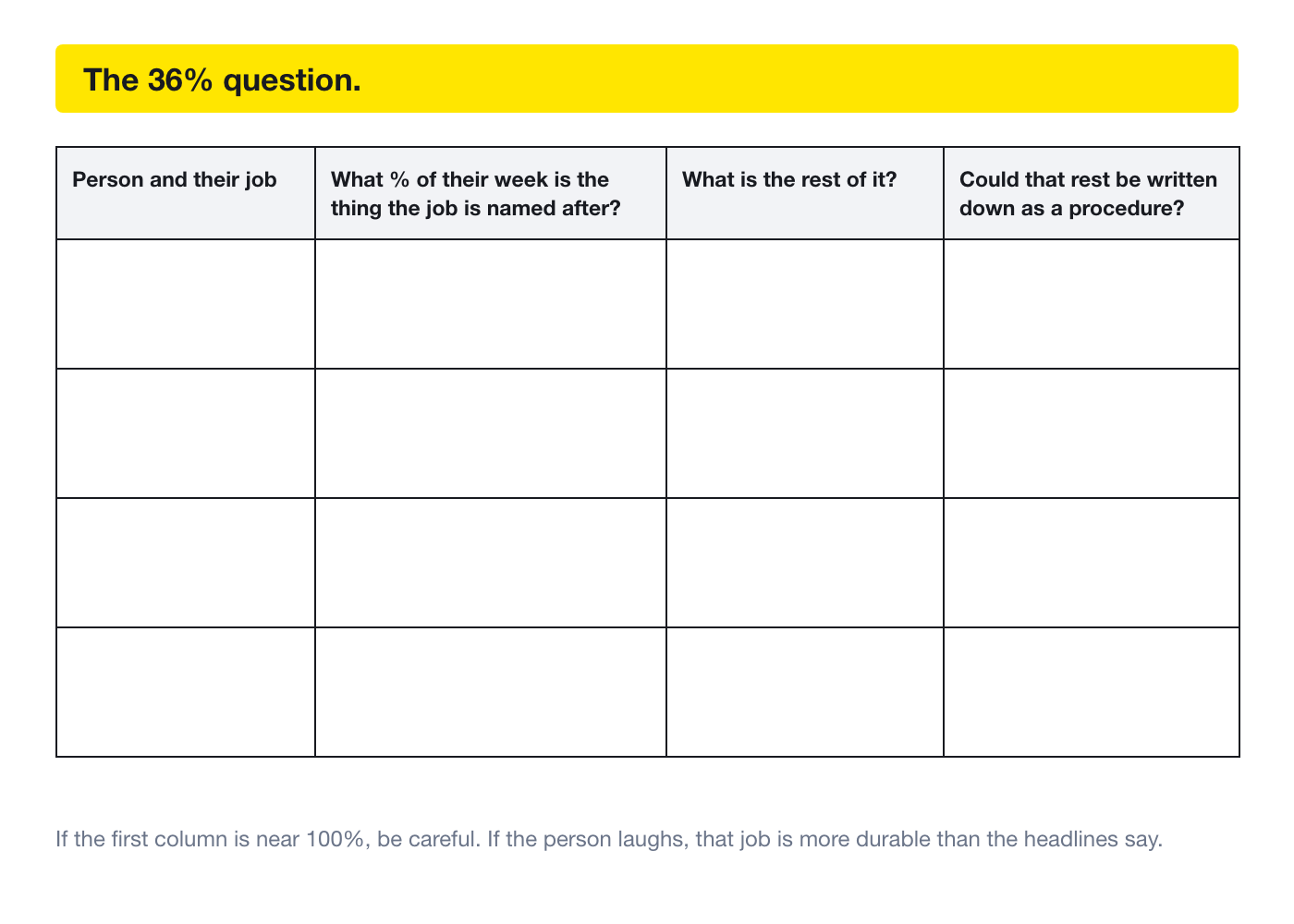
“What percentage of your working week is the thing your job is named after?”
Then ask what the rest of it is.
That single answer will tell you more about that career’s exposure to AI than any list of safe jobs will. It is the radiology question. Ask it of a CA, a lawyer, a developer, a doctor, a teacher, a designer. Write the answers down.
You will find that the jobs where the answer is “almost all of it” are the ones to be careful about. And that the jobs where the person laughs and says “honestly, maybe a third” are more durable than anybody is telling you.
Frequently asked questions
So is any career actually safe from AI?
Should my child still do computer science or engineering?
Is AI going to replace CAs?
Which stream should I take after Class 10 to be safe from AI?
Is it true that AI already does 37% of entry-level work in India?
What is the single most useful thing to do right now?
What we could not check
We would rather tell you this than pretend.
- There is no Indian equivalent of the Stanford payroll study. Nobody has measured AI’s effect on Indian entry-level hiring with employment records. Everything Indian in this guide is job postings, official surveys or company statements. That gap is the most important unknown in the piece.
- We dropped a figure while checking this guide, and we think you should know which one. An analysis published alongside the Economic Survey 2024-25 is widely quoted as showing that “only 8.25% of Indian graduates work in jobs matching their qualifications.” When we traced it, the 8.25% turned out to be one skill tier among four, and a larger tier above it — specialised and professional roles, 38.23% — sits at or above graduate level. The Survey’s own framing is the 53% figure we have used instead. We could not open the Survey chapter itself, only the analysis and reporting of it, so treat 53% as well-sourced rather than primary-verified.
- The ILO’s occupational exposure index does not mention India. It reports exposure by country income level. Any page telling you “the ILO says X% of Indian jobs are exposed” has made that number up.
- NITI Aayog’s 2 million / 4 million figures come with no published methodology. Treat them as a government-endorsed scenario, not a measurement.
- We could not verify the ICAI president’s April 2026 remarks on AI to a primary source, so we have not quoted them. The February 2025 training figures are attributed.
- We could not find any credible India-specific data on AI’s effect on design and content work. The freelance-market research quoted is global and measured in 2022–23, early in the diffusion curve.
- The Prime Minister’s commitment on 15 August 2026 to train one crore youth in AI skills in a year is confirmed on pmindia.gov.in. No scheme name, budget, curriculum or definition of “trained” has been published. For scale: NASSCOM reports that over 2 million Indian professionals have received AI training in total, of whom only 200,000–300,000 have advanced skills.
Where to go from here
If the honest conclusion is “build evidence, not labels,” the obvious next question is what to build and how to start. Two of our guides cover exactly that: Where Teenagers Actually Find Startup Ideas, which is about finding a real problem instead of inventing one, and Learn to Build With AI, which is a checked list of what is genuinely free for a student in India, in rupees.
If what you want is the responsibility part — designing a piece of work and defending it in front of someone who knows more than you — that is what our paid programmes, Research Mentorship and The Builder’s Sprint, are built to do. Nothing in this guide depends on you taking either of them, and none of the advice above changes if you don’t.
One last thought.
Every generation of parents has tried to solve this problem by picking a safe destination for their child. In India the data says that approach has been failing quietly since 1983. AI has not broken it. AI has just made it hard to keep not noticing.
That is uncomfortable, and I think it is also the better of the two situations. A world that rewards the label rewards whoever could afford the label. A world that rewards evidence is at least open to anyone with a problem worth solving and the patience to solve it in public.
So: which career is being argued about at your dinner table? Ask the 36% question this week. The answer is usually more reassuring than the headlines, and more specific than any list.

Nimish · Founder & CEO
20+ years in product and growth, including scaling redBus from 500,000 to 5 million users. MBA from Thunderbird, and founder of Dekoding Brilliance, which designs hands-on programs teaching high-schoolers operational, building, and research skills.